


What Is An Acan Lord Coral?
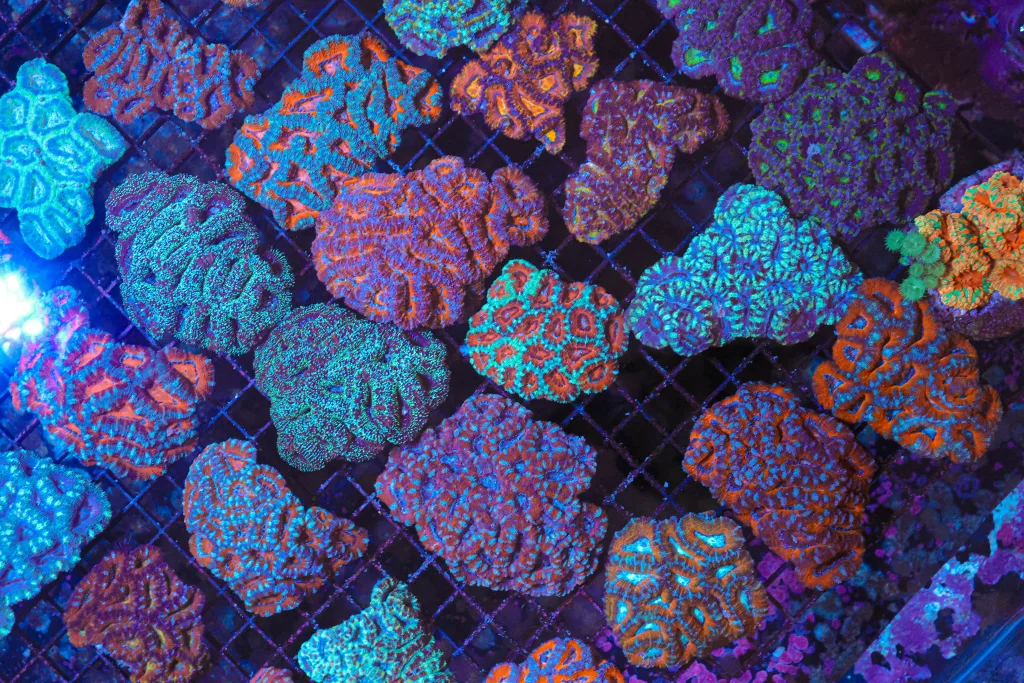
Acan Coral, short for Acanthastrea lordhowensis, is one of the most spectacular and collectable LPS corals in the reef aquarium hobby. My name is March, I am the owner here at Fragbox and I have been keeping and selling Acans for over 16 years. They are one of my absolute personal favourites. The colour combinations available in Acans are almost unmatched in the coral world — vivid reds, oranges, purples, greens, and multicolour ultra varieties from Australia that look like someone painted them by hand. They are peaceful, relatively easy to keep, and incredibly rewarding to grow out and collect.
Acan Names and Origins
Acanthastrea lordhowensis is the scientific name but in the hobby it is simply called Acan Lord or Acan for short. The Lord Howe Island reference in the scientific name hints at its Australian origins — the most prized and colourful specimens come from Australia, particularly the Great Barrier Reef. Australian Acans tend to be red, orange, and multicoloured ultra varieties that command the highest prices. Vietnam and Indonesia also produce Acans in a range of colours including purples and greens that are popular and more affordable. It is worth noting that what was previously classified as Acanthastrea lordhowensis has been reclassified in recent years — many specimens once sold as Acan Lords are now correctly called Micromussa lordhowensis. They are kept identically and the care information here applies equally to both.
Appearance
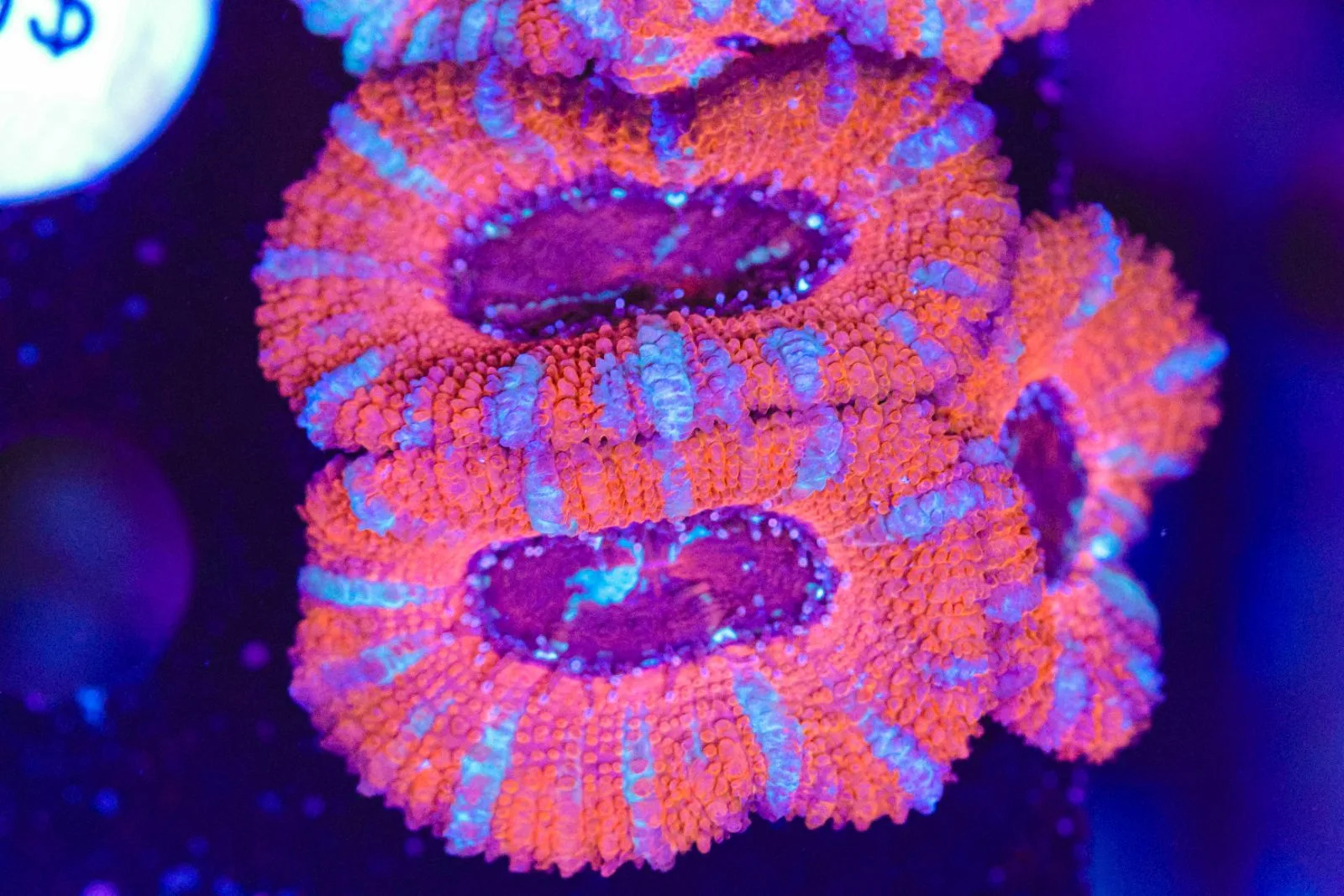
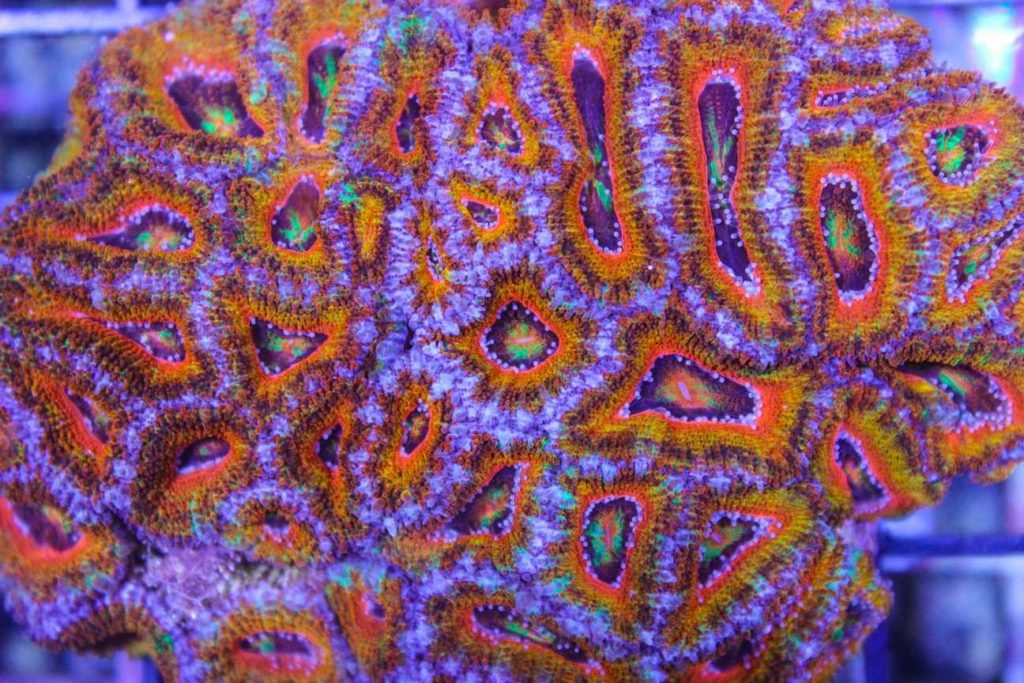
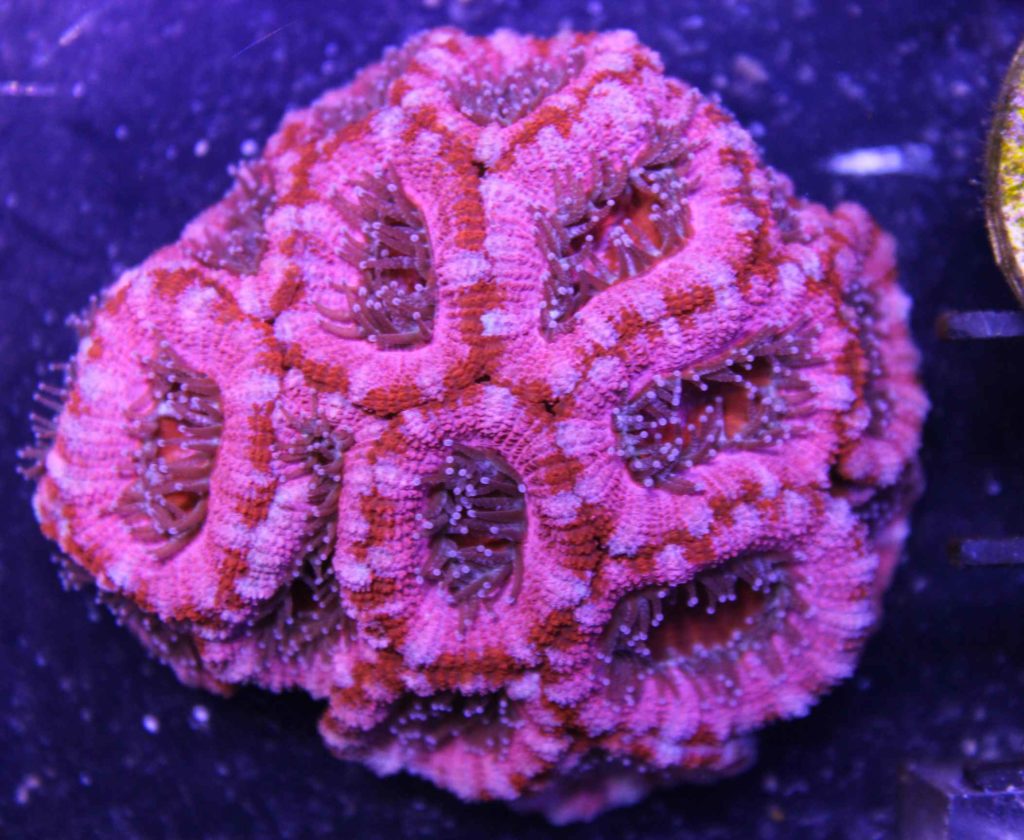
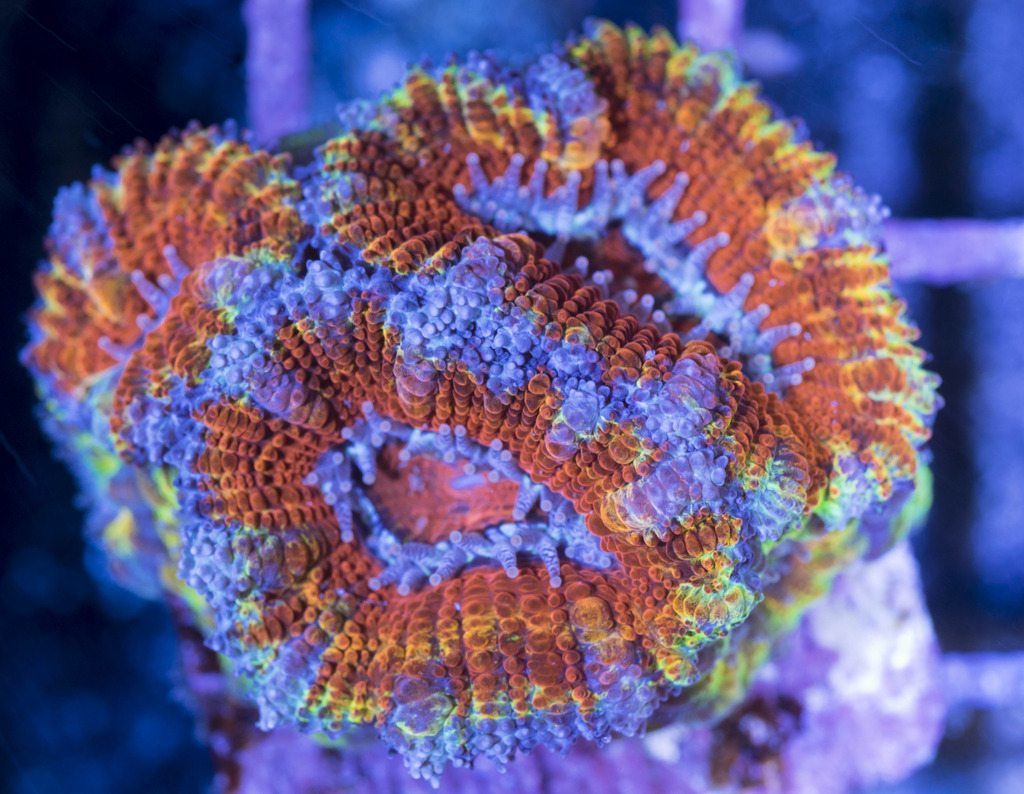
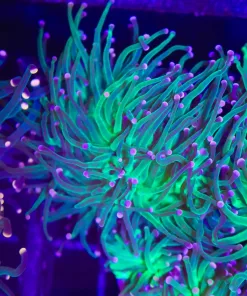
Acan Coral grows as a colony of large, fleshy polyp heads packed closely together on a hard calcium carbonate skeleton base. Each head is a single polyp and healthy Acans have a fluffy, inflated appearance with no exposed skeleton visible anywhere. The tissue is thick, richly coloured, and extends beyond the skeleton base when fully open. Under blue LED actinic lighting Acans put on a show that is hard to beat — the reds and oranges glow, the greens fluoresce, and multicolour ultra varieties look almost neon. A well-lit Acan colony in full display is genuinely one of the most impressive sights in a reef aquarium. They grow by producing new heads from the base of existing ones and a mature colony gradually forms a dome shape as it expands.
Ease of Care
Acan Coral is a beginner friendly LPS with one caveat — it benefits enormously from regular feeding and without it growth is very slow. For a reefer willing to feed regularly Acan is easy, rewarding, and grows steadily. It does not demand intense lighting, is forgiving of moderate parameter swings, and has no aggressive sweeper tentacles. It is peaceful with neighbouring corals as long as they are not Acan Echinata, which we will get to shortly. We always recommend Acan as a great second or third LPS coral for anyone who has mastered the basics of reef keeping and wants to start building a collection of visually striking hard corals.

Acan Lighting
Acan Coral prefers low to medium light. It is found in the wild on deeper sections of the reef where light intensity is reduced. In a home aquarium we recommend placing Acans in the lower third of the tank — on the sand bed or on low lying rock work. PAR levels of 50 to 100 are ideal. Under too much intense light Acans will deflate and lose their colour, bleaching out to a pale, washed out version of themselves. Under the right low to medium light with strong blue actinic spectrum the colours of a well-kept Acan colony are extraordinary. The lower placement in the tank is part of what makes Acans so appealing — they fill an area of the tank that can otherwise be difficult to decorate attractively.
Proper Acan Flow
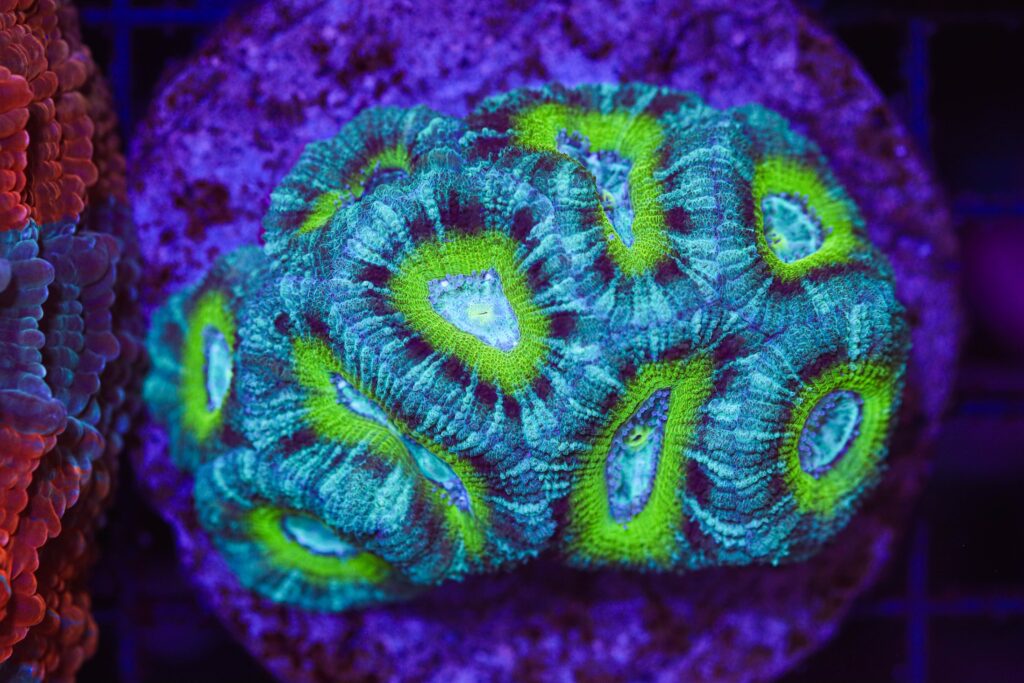
Low to medium indirect flow is what Acan Coral wants. Enough water movement to bring food particles to the polyps and carry away waste and mucus, but not so much that the heads are being deflated or blown around. Acan polyps are large and fleshy and they need to be open and extended to feed and photosynthesize effectively. Direct strong flow from a powerhead will keep the heads permanently deflated and a chronically deflated Acan will not grow and will eventually decline. If your Acan heads are consistently smaller than they should be and look pinched rather than fluffy, reduced flow is the first thing to try. Random indirect flow from a wavemaker on a gentle setting is ideal.
Acan Growth
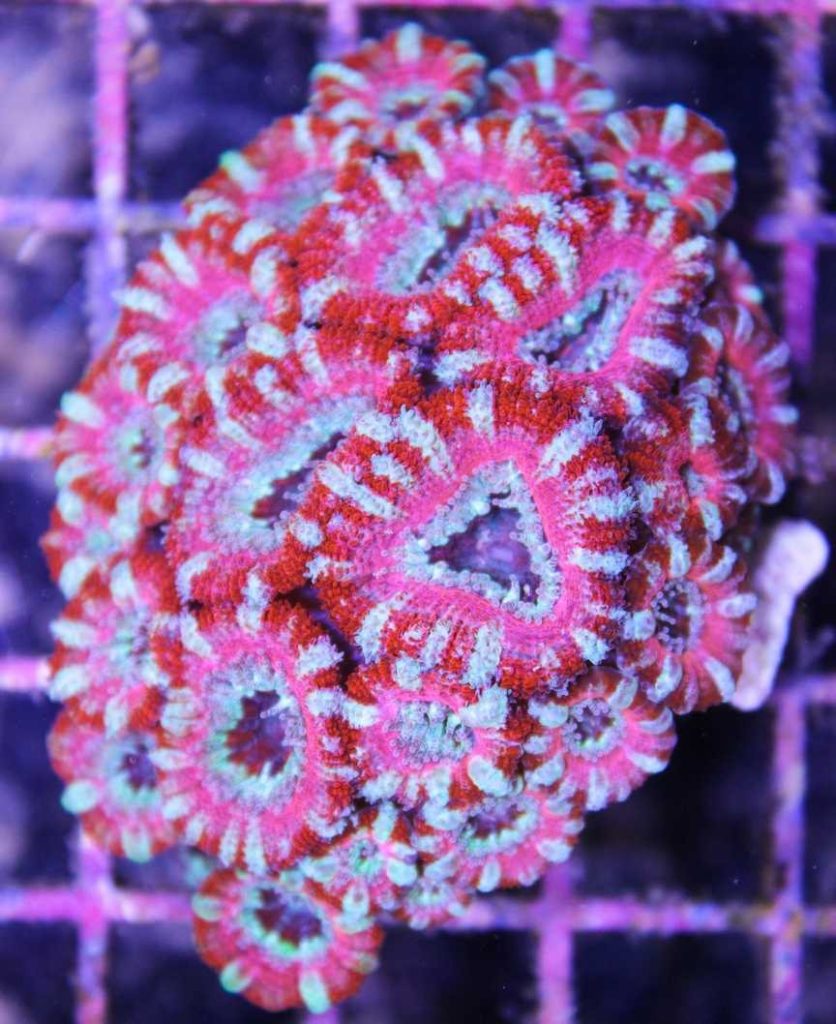
Acan Coral grows by producing new heads — a process called budding where a new polyp develops at the base of an existing one and gradually separates into its own distinct head. Growth is slow without feeding but with regular target feeding it becomes quite satisfying. A two head frag can become a ten head colony within a year with consistent feeding. The colony gradually forms a dome shape as it matures with the newer heads around the outer edge and the older established heads in the centre. Watching a small frag grow into a full dome colony over months and years is one of the genuine pleasures of keeping Acan Coral.
Compatibility — The Acan Echinata Warning
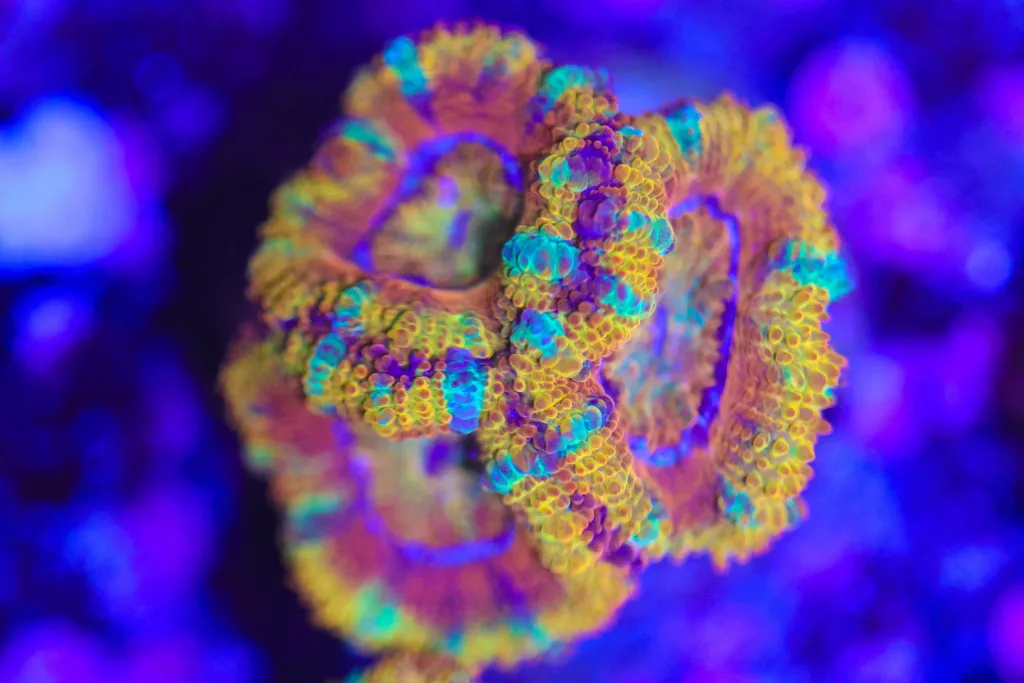
Acan lordhowensis is a peaceful coral that will not sting its neighbours. However there is one critically important compatibility note — Acan lordhowensis will get stung by Acan Echinata. Despite being members of the same genus these two corals are not compatible and Acan Echinata will aggressively attack and damage Acan lordhowensis if they are placed too close together. Always keep these two species well separated. Other than this specific pairing, Acan lordhowensis is one of the most easygoing corals in a mixed reef and can be placed near other peaceful LPS, soft corals, and mushrooms without concern.

Feeding Acan Coral
This is the single most important thing you can do for your Acan Coral. Feeding is not optional if you want your Acans to grow well, colour up, and reach their full potential. Acans are aggressive, enthusiastic feeders with large mouths that will consume meaty foods and LPS pellets readily. Target feeding individual heads while flow is reduced gives the best results — you can watch each head envelop the food and pull it in. We feed our Acans with Fauna Marin Ultra LPS Grow and Color pellets and the difference in growth rate and colour intensity between fed and unfed colonies is dramatic. Feed at minimum twice a week and ideally every two to three days. Highly highly and we cannot stress this enough — HIGHLY feed your Acans.

Water Chemistry
As an LPS coral Acan builds a calcium carbonate skeleton and consumes calcium and alkalinity. We recommend keeping alkalinity at 7.7 to 8.3, calcium at 420 to 450ppm, and magnesium at 1350 to 1450ppm. Stability matters more than hitting exact targets. Acan is more tolerant of slightly elevated nutrients than many hard corals and does not require ultra-low nitrates and phosphates — moderate nutrient levels are well tolerated and can actually encourage better feeding responses. We dose daily with Atoll in our farm and consistent parameters combined with regular feeding produces Acan colonies with remarkable colour and growth.
Propagation
Fragging Acan Coral requires more care than soft corals because you must cut through a hard skeleton and the cut must be made between two heads without damaging either one. Bone cutters or a frag saw work best. Cut as far down between the heads as possible and avoid applying pressure directly to any head. The cut skeleton will heal over time and both the frag and the mother colony will continue to bud new heads from the cut points. Because Acan grows slowly relative to soft corals, frags are more valuable and should be handled carefully. A well grown multi-head Acan frag is a genuinely prized item in the reef community.
Dipping Acan Coral
Always dip Acan Coral before adding it to your tank. A coral dip such as coral rx or two little fishies revive applied for the full recommended time will remove any unwanted hitchhikers. Check out this video on how to dip corals.
![Wysiwyg Tri Color Blue Acan [F11]](https://fragbox.ca/wp-content/uploads/2026/10/F11-247x296.webp)
![Wysiwyg Unique Acan [F1]](https://fragbox.ca/wp-content/uploads/2026/10/F1-247x296.webp)
![Wysiwyg Cherry Acan Frag [F9]](https://fragbox.ca/wp-content/uploads/2026/09/F9-247x296.webp)