
No products in the cart.
Porites
(Porites spp.)
Placement: Middle to Top
Light: High
Flow: HIgh
Care Level: Moderate
Type: SPS
Compatibility: Peaceful
Growth Rate: Moderate
Photosynthetic: Yes
Special Care:
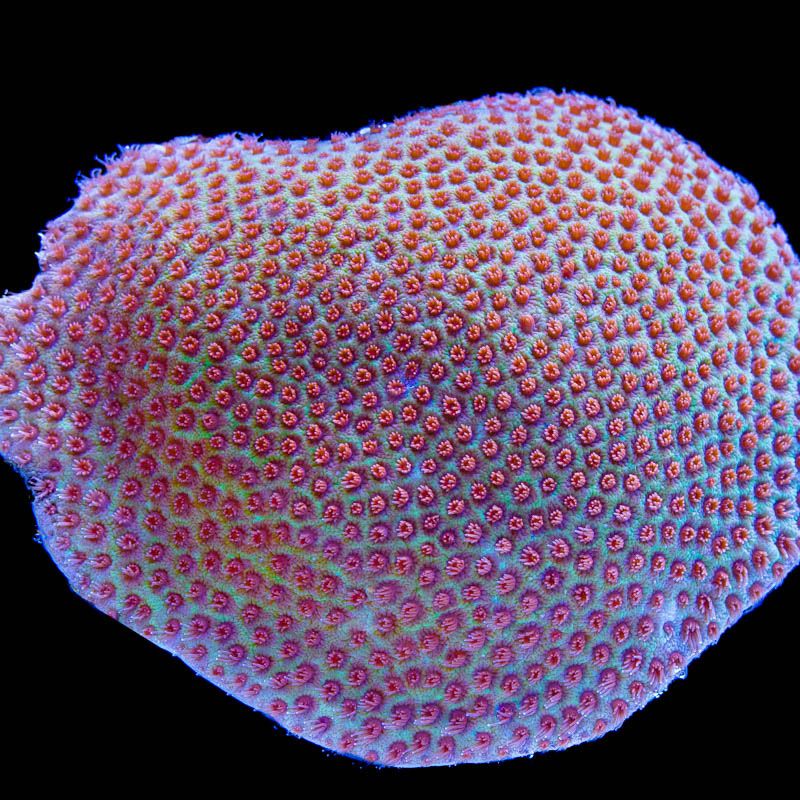
Also known as the Finger Coral or Jewel Coral, the Porites Coral is one of the less well known SPS corals in the hobby. It is found in a variety of growth patterns and colours, but the most common is the green/yellow branching variety. It is also sometimes found as an encrusting coral. It has fairly large and densely packed polyps, which gives it a distinct fuzzy appearance when they are extended.
Porites are found in the Indo-Pacific region but they are also available as aquacultured and maricultured specimens. Generally, smaller, brightly coloured frags are captive bred, whereas larger colonies with less vibrant colours are wild collected. In the ocean, they are most common found on shallow reefs at depths of between 3 and 40 feet. Since they are a light loving coral, they should be placed on an exposed rock ledge in the upper portion of the tank. They are peaceful but can be stung by other, more aggressive corals, so it is important to give them space. While generally regarded as one of the easier SPS corals to keep, they still require a mature tank with stable water parameters.
Like other SPS corals, the Porites Coral prefers high levels of both light and flow. If the coral is turning brown or becoming dull it may be an indication that it is receiving too little light. Conversely, if a coral is bleaching or turning white it may be receiving too much light. Flow should be sufficient to keep detritus from settling on the coral. The polyps should remain extended and visibly move in the flow.
Porites are photosynthetic and can meet their energy needs from the aquarium lighting. They can, however, be spot fed if desired. An SPS specific food such as Vitalis SPS Food makes a good choice for hobbyists who wish to spot feed.
As is the case with other branching SPS corals, fragging Porites is fairly straightforward. Simply cut a branch from the mother colony and glue it to a frag plug and allow it to heal.