What Is Blastomussa Coral?
Blastomussa is one of the most underrated and underappreciated LPS corals in the reef aquarium hobby. My name is March, I am the owner here at Fragbox and I have been keeping and selling Blastomussa for over 16 years. It never gets the spotlight that Acans, Hammers, or Torches get but in my opinion it absolutely deserves more attention. Blastomussa is peaceful, easy to keep, available in beautiful colour morphs, and grows into impressive dome colonies over time. For a reefer who wants a striking LPS coral without the demands of more aggressive or finicky species, Blastomussa is a fantastic choice.

Blastomussa Names and Species
The scientific name is Blastomussa wellsi and it is the most commonly available species in the hobby. There is also Blastomussa merletti which is distinguished by its smaller head size — Wellsi has large fleshy heads typically an inch or more across while Merletti heads are noticeably smaller and more tightly packed. Both species are kept identically and the care information here applies to both. In the hobby they are simply called Blasto or Blastomussa and trade names refer to colour morphs. The most spectacular and sought after varieties come from Australia and often feature vivid reds, oranges, and multicolour combinations with contrasting centre and rim colouration.

Appearance
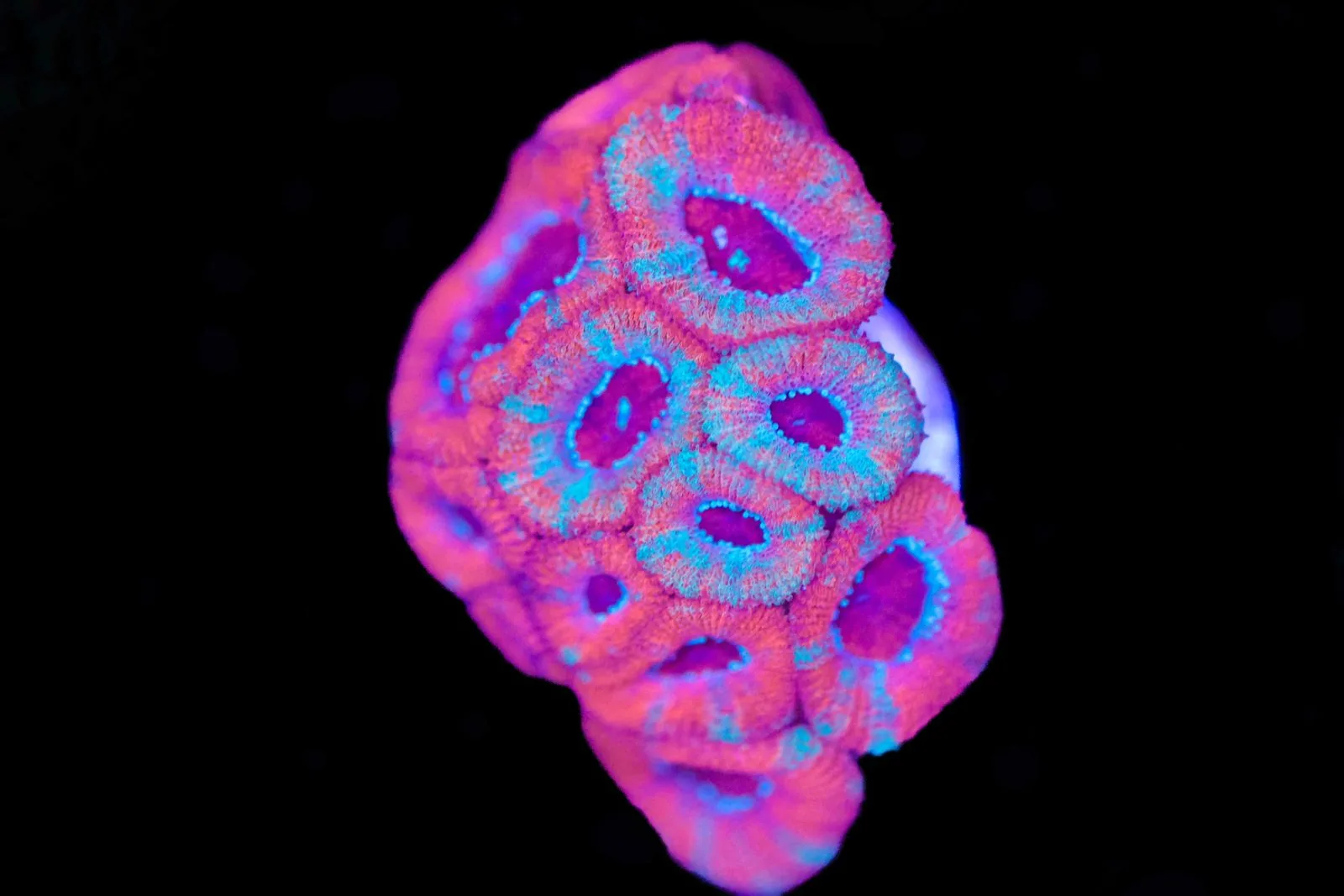
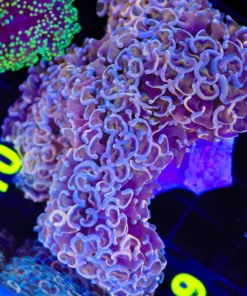
Blastomussa grows as a colony of large, fleshy, round polyp heads on a hard skeleton base. Healthy Blastomussa has a distinctly inflated, bubbly appearance — the heads are thick and round and no skeleton should be visible anywhere. The tissue is richly coloured and when fully open the heads extend beyond the skeleton base giving the colony a lush, full appearance. Blastomussa does have delicate tentacles that emerge at night for feeding — these are fine and relatively short compared to other LPS corals and are not aggressive. Under blue LED actinic lighting the reds and greens of Blastomussa produce beautiful fluorescent effects. A mature dome colony of Blastomussa with dozens of heads is genuinely one of the most beautiful things you can grow in a reef tank.

Ease of Care
Blastomussa is a beginner to intermediate level coral that is genuinely forgiving in most conditions. It does not demand intense lighting, is tolerant of moderate parameter fluctuations, and is completely peaceful so placement is straightforward. The one thing that elevates it from pure beginner territory is that it truly benefits from regular feeding — without feeding it survives but with feeding it transforms, growing noticeably faster and producing richer, more saturated colour. Think of Blastomussa like Acan Coral in this regard — technically easy to keep alive, but feeding is what takes it from surviving to thriving.

Blastomussa Lighting
Blastomussa prefers low to moderate light. It is found in sheltered reef environments in the wild where light intensity is reduced. In a home aquarium we recommend placing it in the lower third of the tank on the sandbed or on low lying rock work. PAR levels of 50 to 150 are ideal. Under too much intense light the heads will deflate, colour will pale out, and the coral will stress. Under appropriate lower light conditions with a strong blue actinic spectrum the colour intensity and fluorescence of Blastomussa is remarkable. If your Blastomussa heads are consistently smaller or more deflated than expected, reducing light intensity is the first thing to try.

Proper Blastomussa Flow
Low flow is the key requirement for Blastomussa. This is one of the most low-flow tolerant LPS corals in the hobby and it prefers gentle, indirect water movement. Strong or direct flow will deflate the heads and keep them pinched looking rather than the full, bubbly, inflated appearance that indicates a healthy, happy Blasto. Place it in the most sheltered area of your tank — behind rock work, in a corner, or anywhere the flow is soft and diffuse. A gentle wavemaker on a low setting pointed away from the coral is ideal. If your Blastomussa looks deflated and pinched and you have ruled out lighting, check your flow — too much flow is the most common reason Blastomussa fails to open fully.

Blastomussa Growth
Blastomussa grows by budding new heads from the base of existing ones. Growth is slow compared to soft corals but steady and satisfying. A small two or three head frag will develop into a respectable colony over the course of a year with regular feeding, and over several years it builds into an impressive full dome shape that becomes a real focal point in the tank. The older heads in the centre of a mature colony gradually show more skeleton at the base as the tissue extends upward while the newer heads around the outer edge are always the fullest and most colourful. This dome growth form is part of what makes a mature Blastomussa colony so visually striking.

Compatibility
Blastomussa is one of the most peaceful LPS corals in the hobby. It does not have aggressive sweeper tentacles and will not attack neighbouring corals. However it is on the receiving end of aggression — Blastomussa can be easily stung by Acan Echinata, Torch Coral, Hammer Coral, and other aggressive LPS with sweeper tentacles. Always give Blastomussa a safe buffer distance from any coral known to be aggressive. Its peaceful nature and low placement requirements make it an excellent companion for other low-light, low-flow species like Florida Ricordea, mushroom corals, and Acans — all of which share similar placement preferences in the lower sections of the tank.

Feeding Blastomussa Coral
Feeding is where you will see the most dramatic improvement in your Blastomussa. It is photosynthetic and will survive on light alone but regular target feeding produces noticeably faster growth, larger head size, and significantly better colour saturation. Blastomussa accepts meaty foods and LPS pellets readily. Reduce your flow temporarily, target feed individual heads, and you will quickly see the heads envelop the food. We feed our Blastomussa with Vitalis LPS pellets in our farm and the difference between fed and unfed colonies is striking — fed colonies have larger, richer, more inflated heads and grow new buds noticeably faster. Feed at minimum twice a week for best results.

Water Chemistry
As an LPS coral Blastomussa builds a calcium carbonate skeleton and consumes calcium and alkalinity, though more slowly than more aggressive growing hard corals. We recommend keeping alkalinity at 7.7 to 8.3, calcium at 420 to 450ppm, and magnesium at 1350 to 1450ppm. Stability is more important than hitting exact targets. Blastomussa is more tolerant of slightly elevated nutrients than many hard corals and does not require ultra-low nitrates and phosphates — moderate nutrient levels are fine and will not prevent it from thriving. We dose daily with Atoll in our farm and consistent parameters combined with regular feeding produces Blastomussa colonies with exceptional colour and steady growth.

Propagation
Blastomussa can be fragged but requires care because you are cutting through a hard skeleton. Bone cutters work best. Cut between two heads as far down toward the base as possible — cutting too close to the heads risks damaging the tissue. The cut surfaces will heal over time and both the frag and the mother colony will continue budding new heads from the cut points. Because Blastomussa grows slowly, frags are more valuable than soft coral frags and should be handled carefully. A well-grown multi-head Blastomussa frag in a sought after colour morph is a genuinely prized item in the reef keeping community.
Dipping Blastomussa Coral
Always dip Blastomussa before adding it to your tank. A coral dip such as coral rx or two little fishies revive applied for the full recommended time will remove any unwanted hitchhikers.

Blood Shrimp
Wysiwyg Anemone (C152)
Wysiwyg Green Serpent Mushroom Coral [F95]
Sun Coral Frag (Row #4)
Wysiwyg Zoanthid Frag [F96]
Lemon Drop (Row #7:B)