



What Are Green Star Polyps?
Green Star Polyps, universally known in the hobby as GSP, are one of the most popular and widely kept soft corals in the reef aquarium world. My name is March, I am the owner here at Fragbox and I have been keeping and selling GSP for over 16 years. It is one of the very first corals we recommend to anyone starting a reef tank. GSP is virtually indestructible, grows at an impressive pace, and under blue LED actinic lighting it puts on one of the most visually striking displays of any soft coral available. A mat of fully open GSP swaying in the flow is a genuinely mesmerizing sight.
Green Star Polyp Names
Green Star Polyps go by several names in the hobby — GSP is the most common abbreviation, and you will also hear them called Star Polyps, Encrusting Star Polyps, and occasionally Daisy Polyps. The scientific name is Pachyclavularia violacea. Despite the name suggesting a purple colouration, the most common and widely available variety has bright green polyps that emerge from a dark purple to black encrusting mat. There is also a white variety that is less commonly available, and under certain lighting conditions some specimens show a beautiful teal or blue-green colouration. At Fragbox we have been aquaculturing our own GSP in house for years and rarely need to import it at all.
Appearance
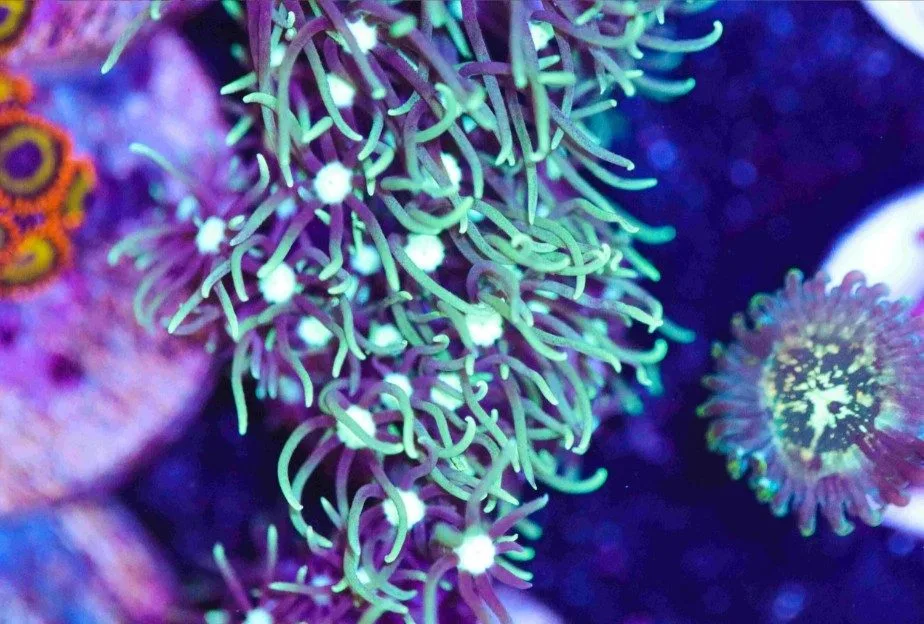
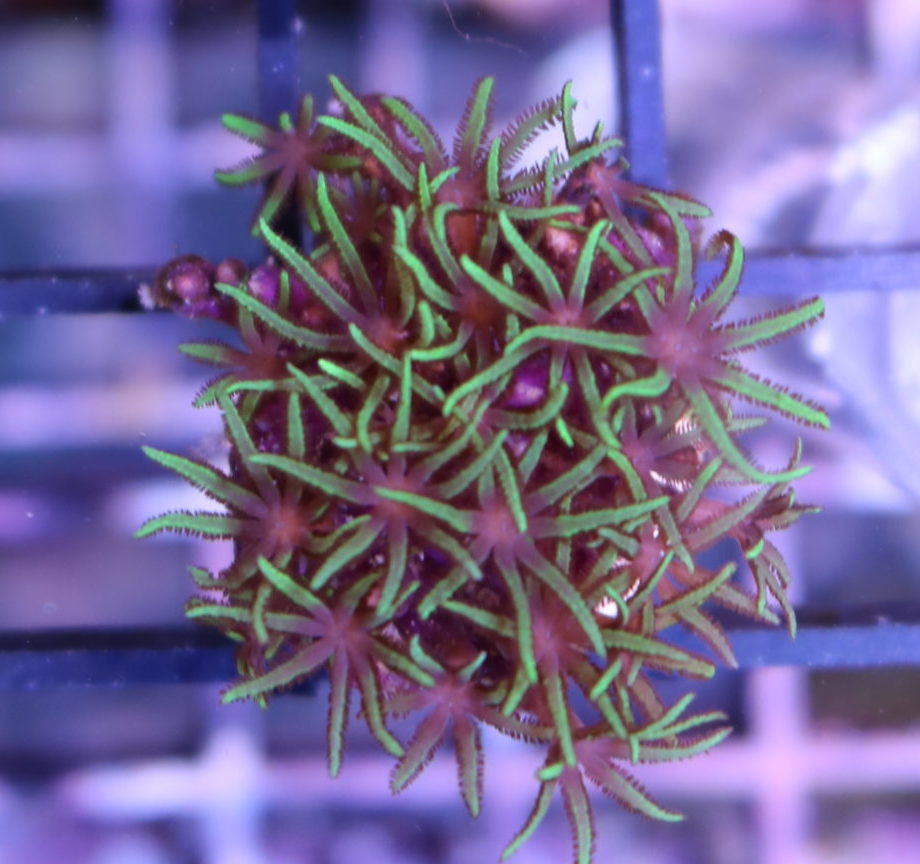
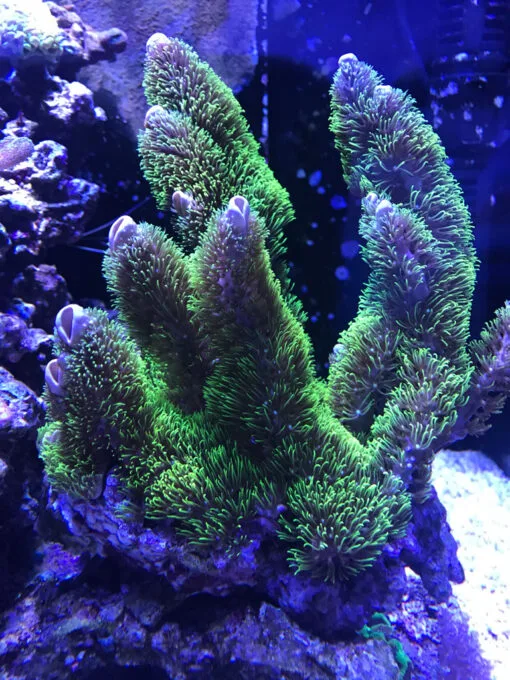
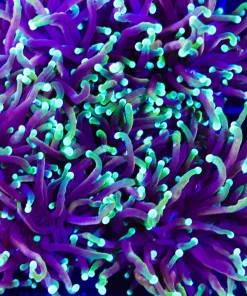
GSP grows as a flat encrusting mat of purple to dark brown tissue that spreads across rock and other surfaces. From this mat hundreds of individual polyps emerge — each one a small star-shaped polyp with eight feathery tentacles that extend when open and retract completely when disturbed. When the entire colony is open and the polyps are extended in unison the result is an incredible lush, bright green carpet that sways gently in the current. The transformation from the bare dark mat when closed to the vivid green carpet when open is remarkable — it is one of those corals that can look completely different from one hour to the next. Under strong blue LED actinic lighting the green fluorescence is extraordinary.
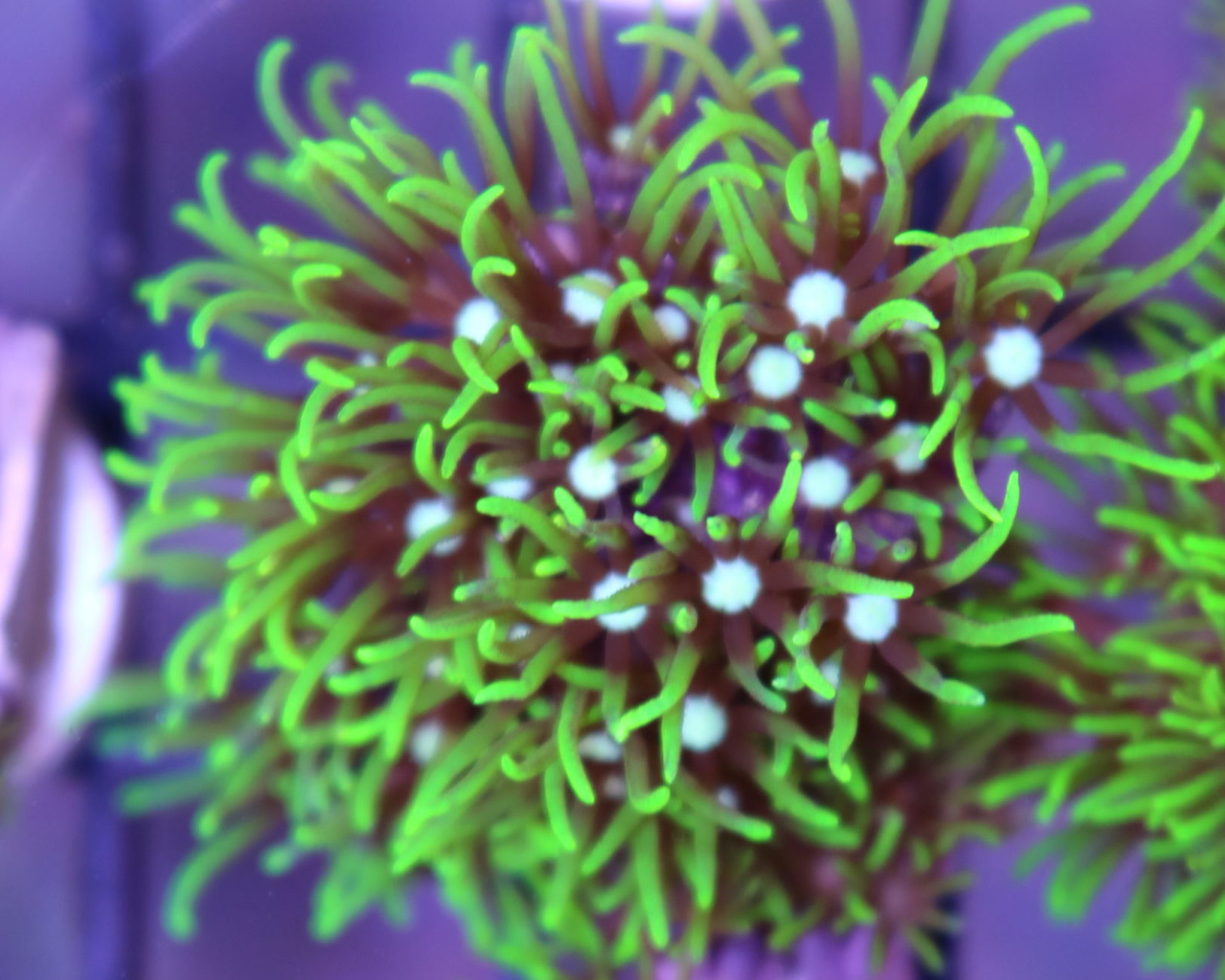
One of the nicer varieties of Green Star Polyp
Ease of Care
GSP is about as beginner friendly as a coral can be. It tolerates a huge range of lighting conditions from quite low to quite high. It is forgiving of elevated nutrients, less than perfect water quality, and parameter swings that would stress more demanding corals. It does not need to be fed. It does not have a complex skeleton to maintain. It grows in almost any reef aquarium that has basic functioning lighting and flow. We have seen GSP thrive in tanks that we would not recommend for most other corals. If you cannot grow GSP, the problem is almost certainly not the coral. For anyone new to reef keeping GSP is one of the three corals we always suggest starting with alongside mushrooms and zoanthids.
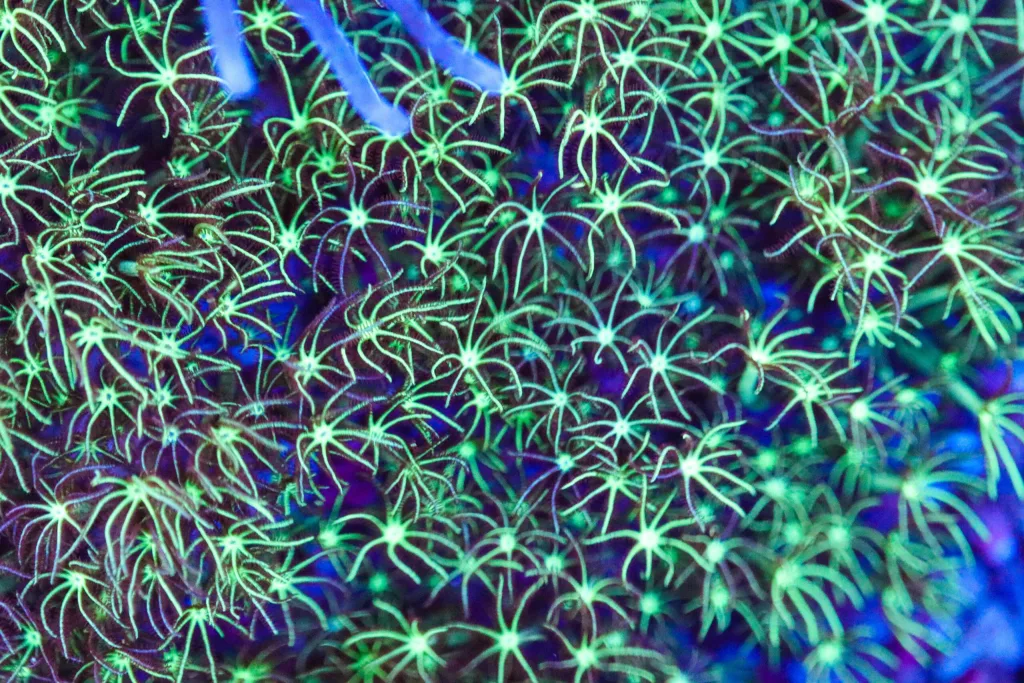
Green Star Polyp Lighting
GSP is one of the most adaptable corals when it comes to lighting. It does well under low, medium, and high light conditions and will adjust over time. That said it tends to show its best colour and growth under low to medium light — PAR levels of 50 to 200 all produce good results. Under very high intensity light the polyps can become shorter and the colony may not open as fully. Under blue LED actinic spectrum lighting the green fluorescence of the polyps is absolutely spectacular — this is when GSP looks its absolute best. We place our GSP in the lower to middle sections of our grow-out systems and it thrives without any special attention. As long as the polyps are extending regularly your lighting is adequate.
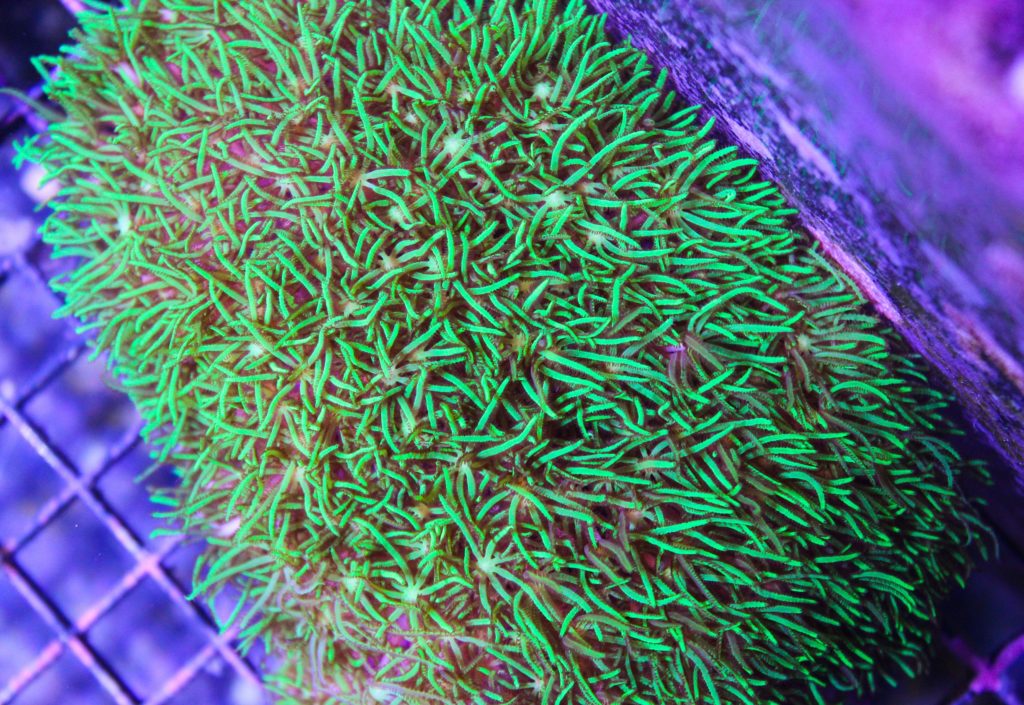
Proper Green Star Polyp Flow
GSP does well in a wide range of flow conditions from low to high. Moderate indirect flow is ideal — enough to keep the polyps swaying and bring food particles across the colony, but not so much direct blasting that the polyps stay permanently retracted. If your GSP mat is not opening, check for direct flow from a powerhead first. Random flow from a wavemaker is ideal. One interesting behaviour of GSP is that it will sometimes close for a day or two spontaneously even in perfect conditions — this is completely normal and is thought to be a periodic sloughing behaviour where the coral sheds a thin layer of mucus and dead tissue. If your GSP closes for a couple of days and then reopens fully there is nothing to worry about.
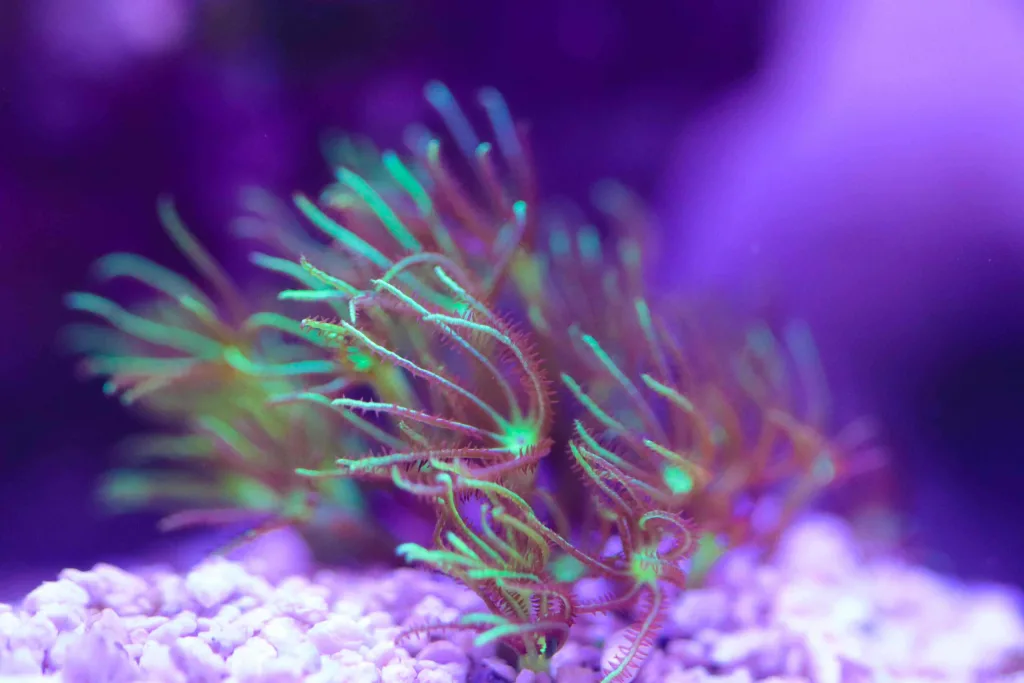
Green Star Polyp Growth and Placement
GSP is one of the fastest growing corals in the hobby and this is both its greatest appeal and its one management consideration. A frag plug covered in GSP can spread to cover an entire rock within months in a healthy tank. It will grow over and onto anything it contacts — neighbouring rock, the glass, equipment, and other corals. This invasive quality is something to plan for before you place your GSP. We strongly recommend placing GSP on an isolated rock or on a rock island on the sandbed that is not connected to your main aquascape. It also looks spectacular growing on the back wall of your aquarium where it can spread freely without threatening other corals. Many reefers dedicate an entire wall section of their tank to GSP and the result is stunning.
Compatibility
GSP has no sting and will not harm neighbouring corals directly. It is the encrusting growth that is the compatibility concern — GSP will literally grow over other corals if they are too close and it will smother them. It is not aggressive in the traditional sense but it is invasive in the physical sense. Plan your placement carefully and give GSP its own dedicated territory. Some reefers create a moat around their GSP rock by placing it on the sandbed away from the main rock work. Others place it on the back glass of the tank. Either approach works well and the key is simply that GSP needs its own space to do its thing without encroaching on your other corals.
Green Star Polyp Feeding
GSP is photosynthetic and meets all of its energy needs from light alone. It does not need to be fed and we do not feed our GSP colonies in our farm at all. It will passively benefit from the presence of dissolved organics and fine particles in the water column but direct target feeding is unnecessary. This makes GSP one of the most low maintenance corals you can keep — good lighting, reasonable flow, and it looks after itself. For a beginner this hands-off quality is incredibly valuable.
Water Chemistry
We always recommend keeping your aquarium within natural sea water parameters — salinity of about 1.026, calcium 450ppm, alkalinity of about 8, and magnesium 1400. GSP is a soft coral and does not build a hard calcium carbonate skeleton so it does not consume calcium or alkalinity in any meaningful way. It is highly tolerant of elevated nutrients — nitrates and phosphates that would stress SPS corals are well tolerated by GSP. This makes it one of the best choices for newer tanks that have not yet fully stabilised their nutrient export.
Propagation
GSP is one of the easiest corals to propagate and is an excellent coral to learn fragging on. Because it grows as a flat encrusting mat you can simply cut a piece from the edge of a colony with scissors or a razor blade and glue it flat to a new rock or frag plug. The piece of mat will begin encrusting over the new surface within days and polyps will start emerging within a week. Because of the fast growth rate there is always plenty of material to work with and the mother colony recovers immediately from fragging. We produce enormous quantities of GSP frags from our aquaculture colonies in Toronto and it is one of our most self-sustaining corals to grow.
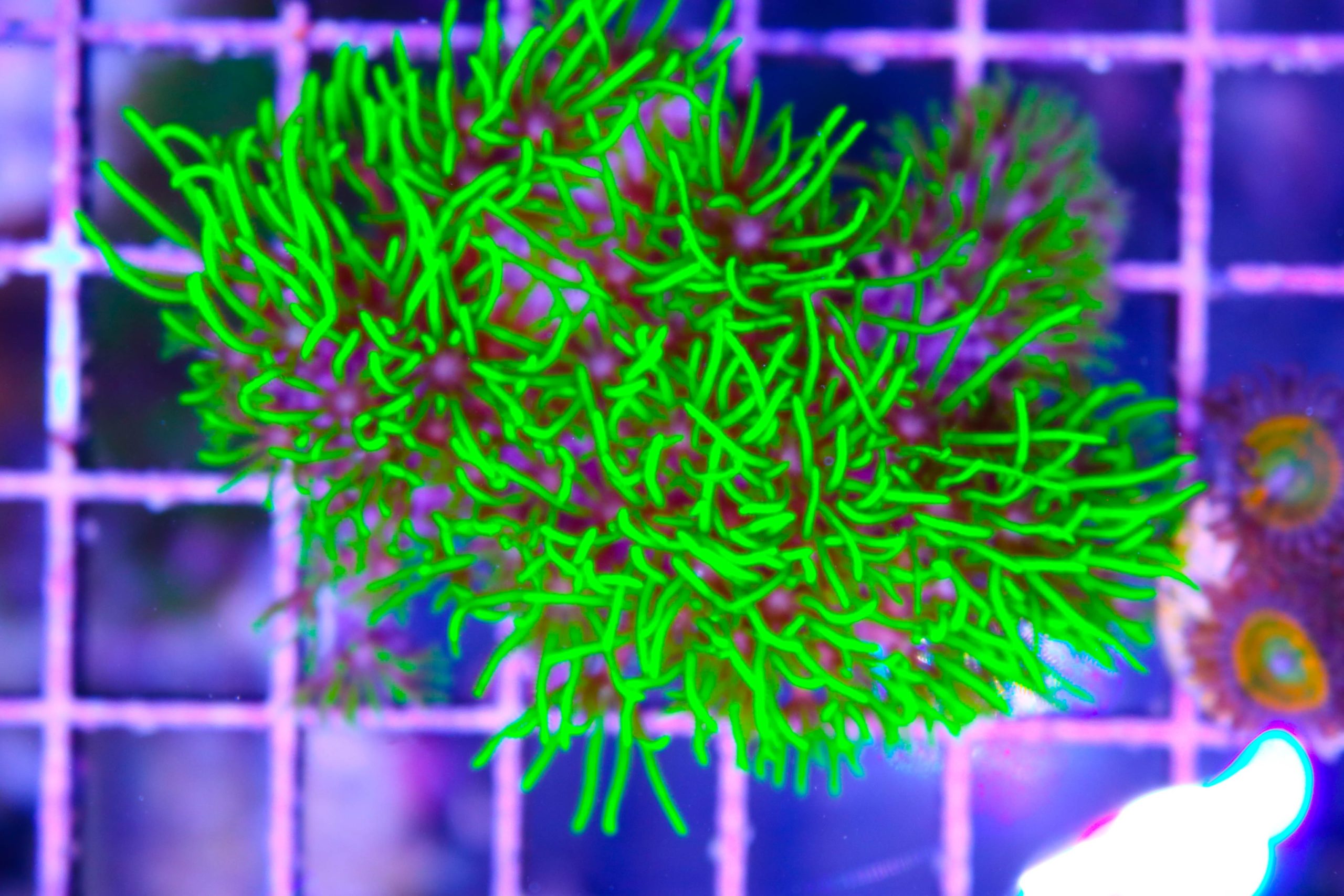
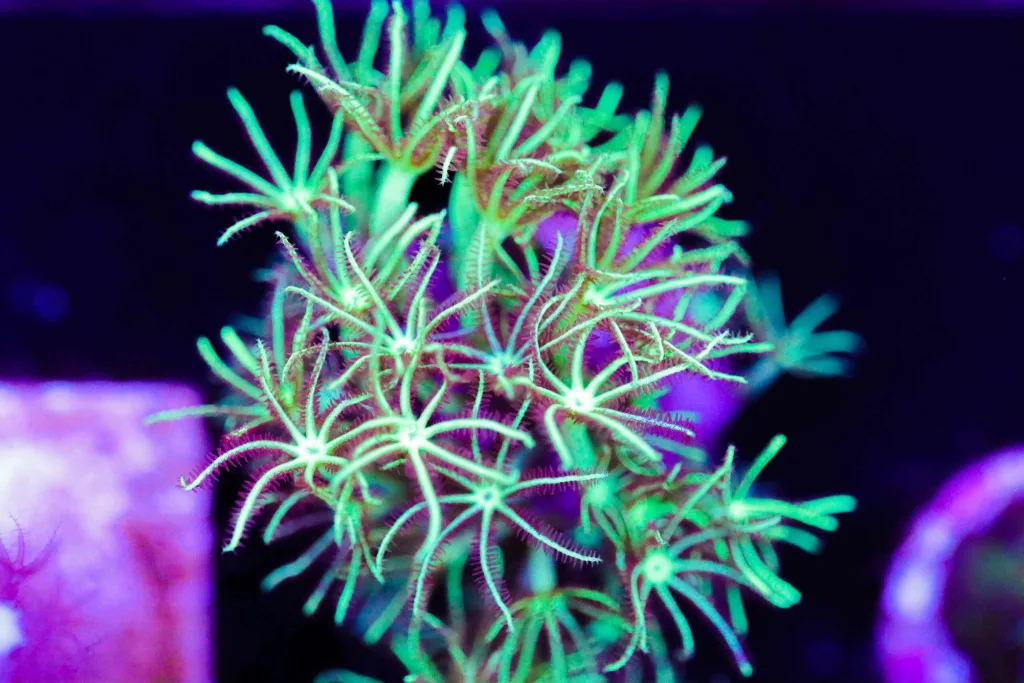
Yet another slight variation in GSP
![Wysiwyg Time Twiser Discosoma Mushroom | Very Unique Color / Pattern [F25]](https://fragbox.ca/wp-content/uploads/2026/09/F25-247x296.webp)
![Wysiwyg Tri Color Blue Acan [F11]](https://fragbox.ca/wp-content/uploads/2026/10/F11-247x296.webp)
![Wysiwyg Ricordea Yuma Mushroom [F36]](https://fragbox.ca/wp-content/uploads/2026/10/F36-247x296.webp)
![Wysiwyg Rhodactis Mushroom [F35]](https://fragbox.ca/wp-content/uploads/2026/10/F35-247x296.webp)
![Wysiwyg Blastomussa Frag [F12]](https://fragbox.ca/wp-content/uploads/2026/09/F12-247x296.webp)
![Wysiwyg Ricordea Yuma Mushroom [F33]](https://fragbox.ca/wp-content/uploads/2026/10/F33-247x296.webp)