



What Are Discosoma Mushroom Corals?
Discosoma Mushroom Corals are one of the most iconic and beloved soft corals in the reef aquarium hobby. My name is March, I am the owner here at Fragbox and I have been keeping and selling Discosoma mushrooms for over 16 years. They are the coral that got me into the hobby in the first place and I have a deep affection for them. Discosoma mushrooms are extraordinarily hardy, grow fast, come in an almost unlimited range of colour variations, and require virtually no special care. They are the perfect coral for a beginner and remain endlessly collectable for experienced reefers chasing rare and unusual colour morphs.
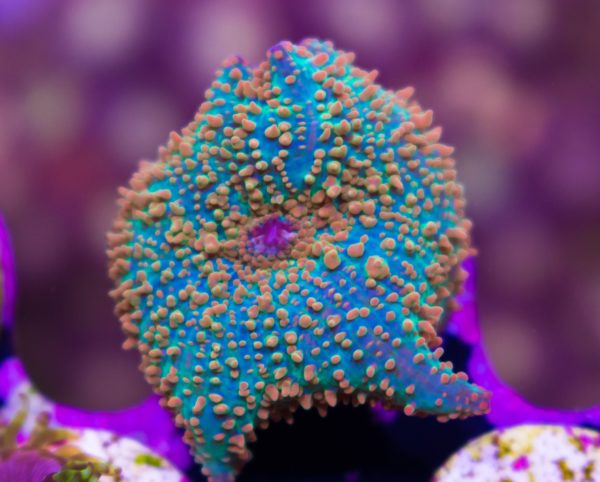
Discosoma Names and Varieties
Discosoma is the scientific genus name but in the hobby these corals are simply called mushrooms, shrooms, or corallimorphs. The Order Corallimorpharia contains several genera — Discosoma, Rhodactis, and Ricordea being the most commonly kept. Discosoma is the most widespread and beginner friendly of the three. Each colour variation has a fun trade name and collecting the different morphs is genuinely addictive — Tequila Sunrise, Superman, Afterburner, Interstellar, Jawbreaker, and hundreds of others. Some ultra rare Discosoma morphs command surprisingly high prices despite being technically one of the easiest corals to grow. The variety available in this one genus is staggering.
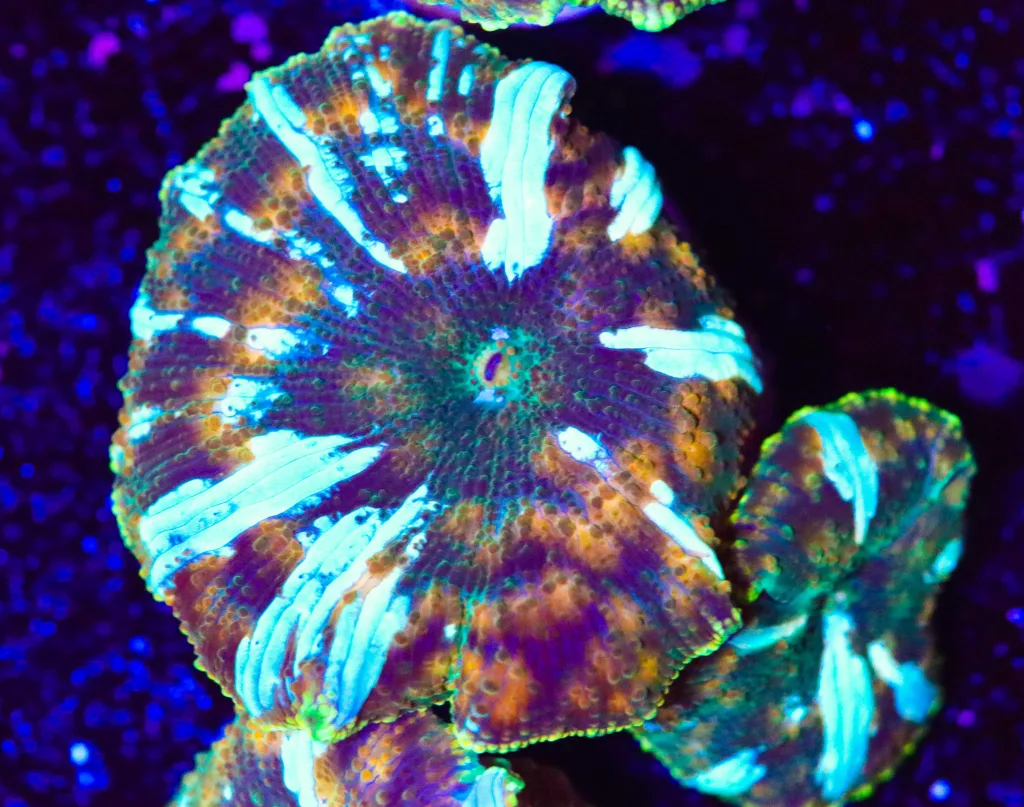
Appearance
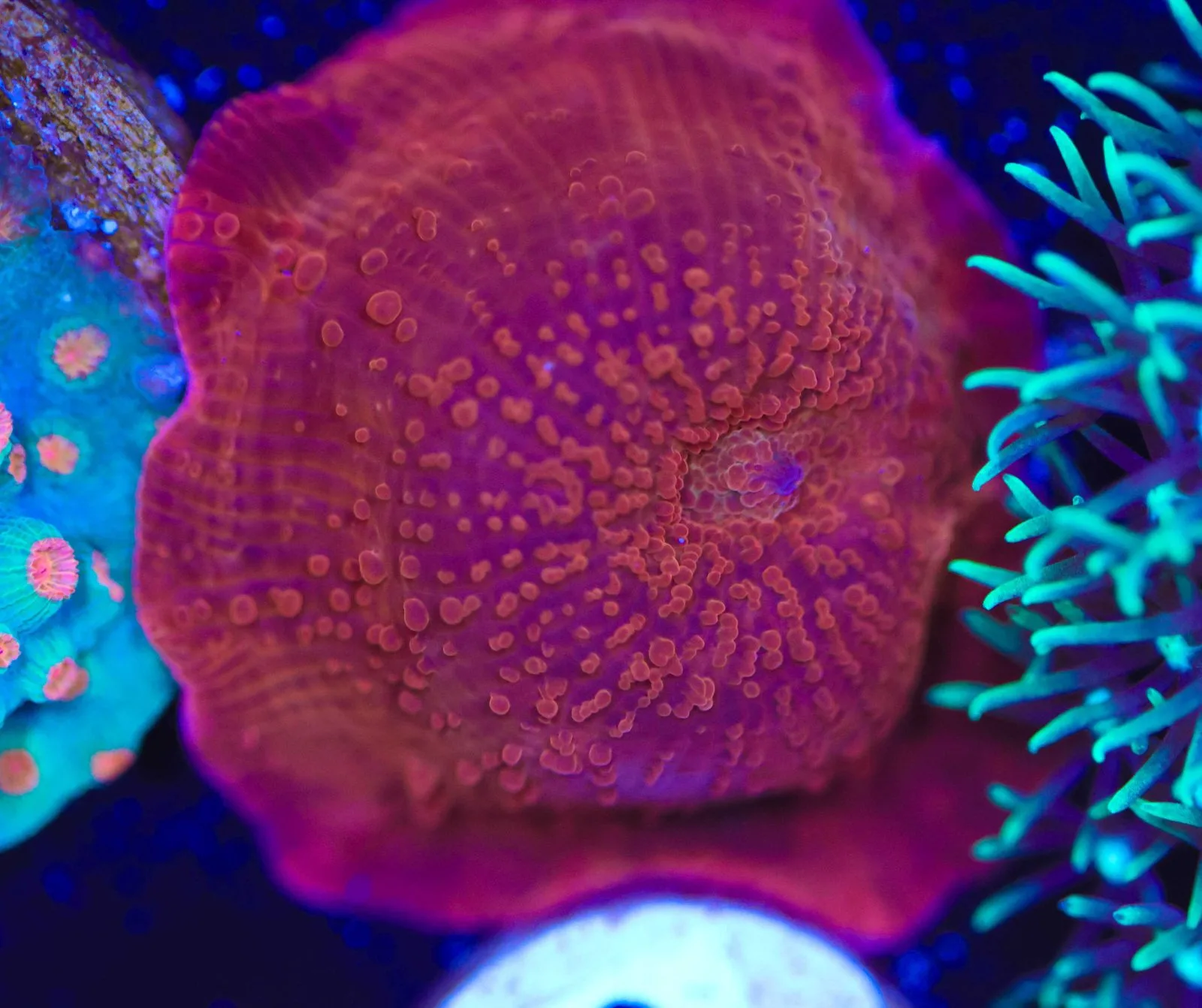
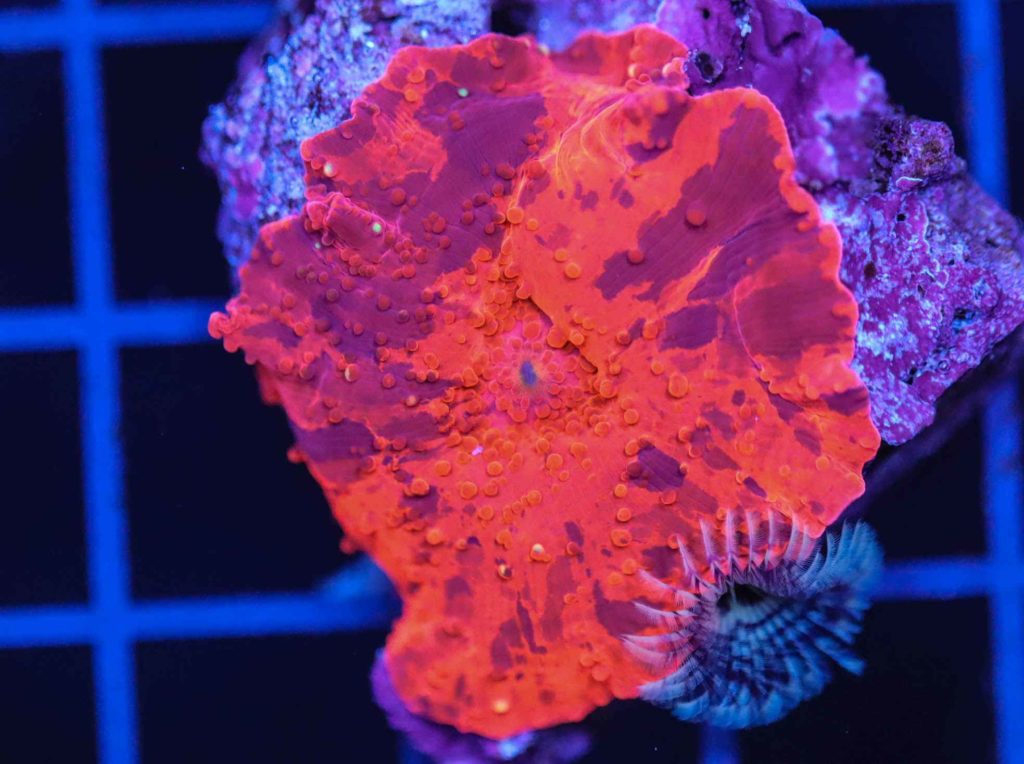
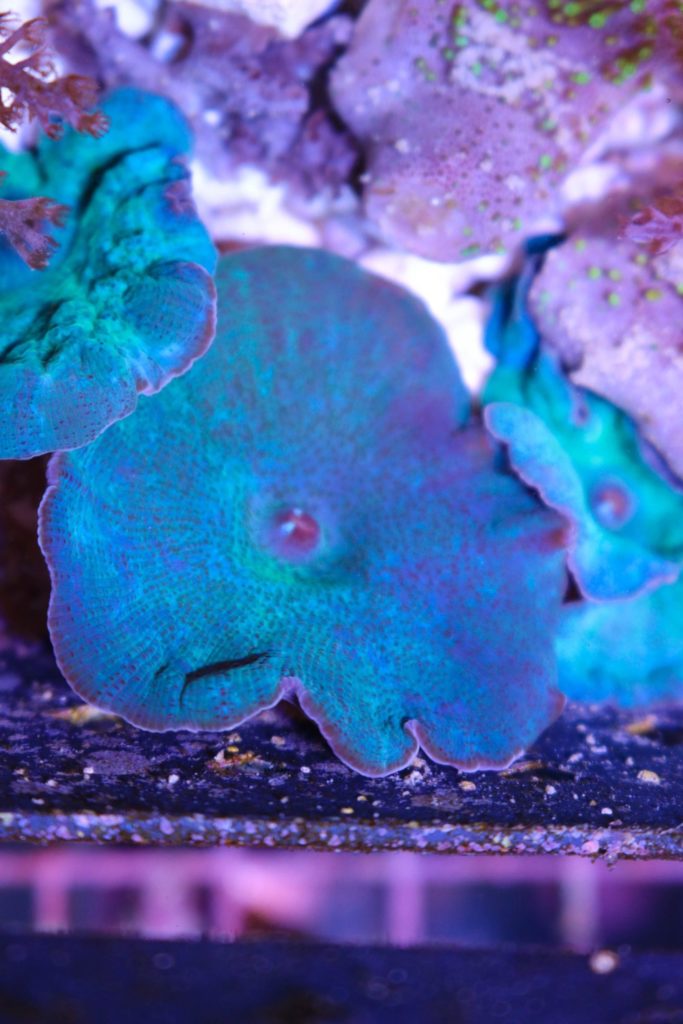
Discosoma Mushroom Corals grow as flat to slightly domed disc-shaped polyps that attach to rock by a fleshy foot. Each polyp is a single independent organism. The surface texture ranges from completely smooth to covered in small bumps or ridges depending on the variety. Colours range from the most basic greens and browns to electric neons, multicolour patterns, and varieties that look almost painted. Under blue LED actinic lighting the fluorescent morphs produce a glow that is hard to believe is natural. The polyps open fully in good conditions and retract completely when disturbed — a healthy, open Discosoma looks like a colourful, fleshy disc floating above the rock.
Ease of Care
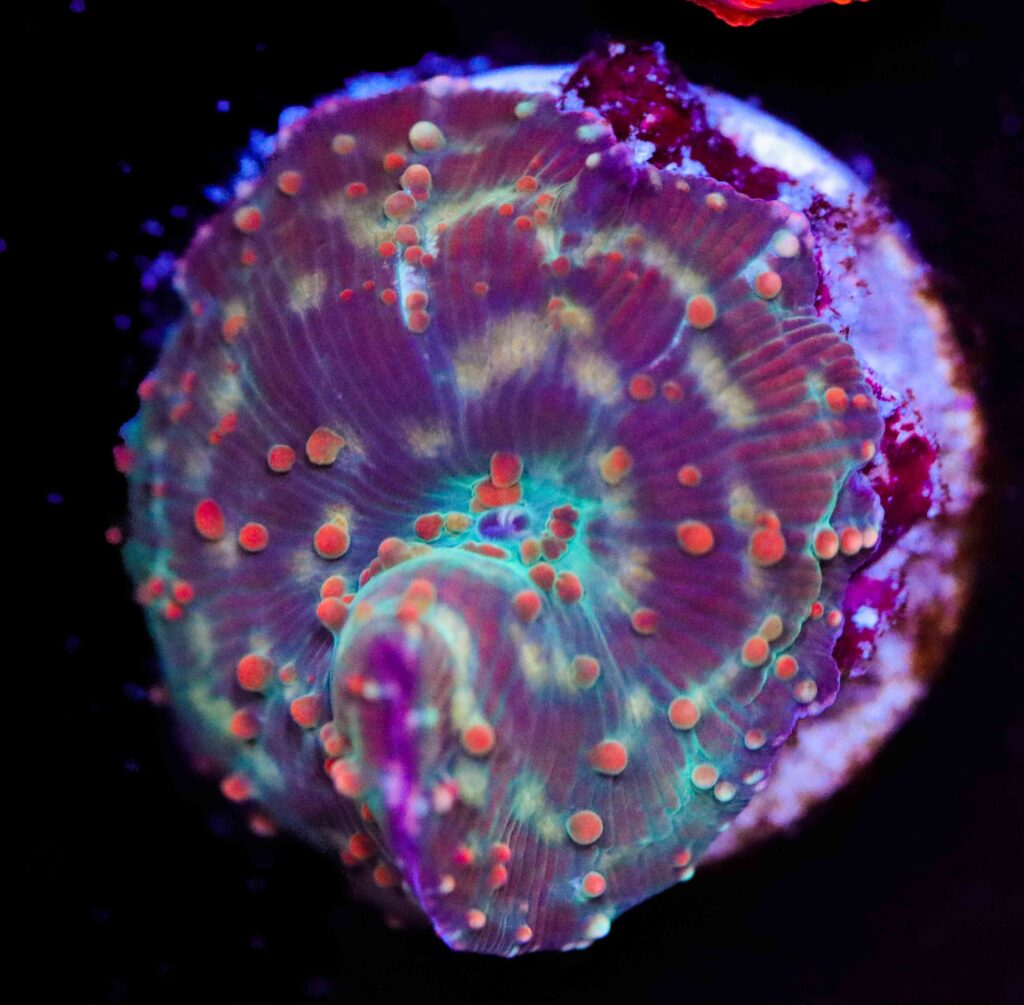
Discosoma Mushroom Corals are without question among the easiest corals to keep in a reef aquarium. They tolerate low light, higher nutrients, less stable parameters, and lower flow than almost any other coral. They thrive in tanks that would be considered unsuitable for most other corals. They do not build a hard skeleton so they have no calcium or alkalinity demands. They are photosynthetic and require no feeding to survive and grow. For a new reefer looking for their first coral, Discosoma mushrooms are one of our top three recommendations alongside zoanthids and Kenya Tree. The only real way to kill a Discosoma is to blast it with direct intense flow, blast it with extreme lighting, or put it in a tank with no light at all.
Discosoma Lighting
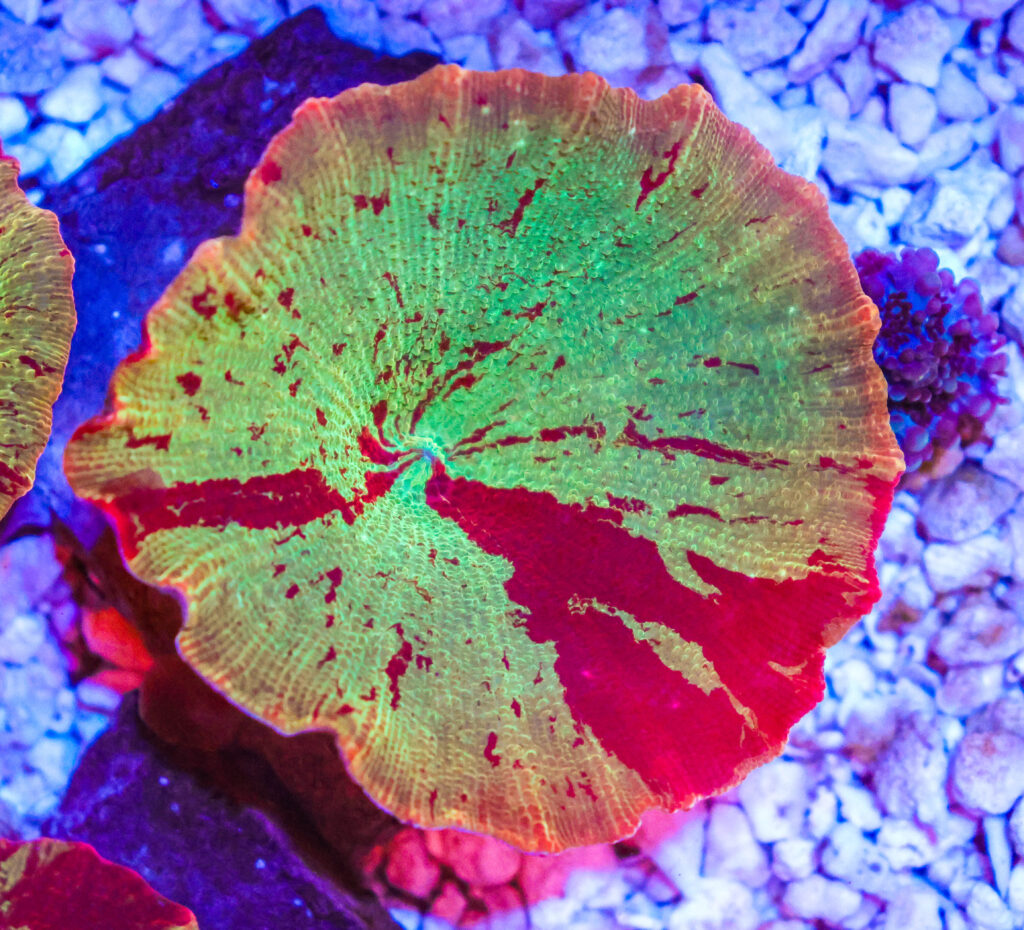
Discosoma Mushroom Corals prefer low to moderate light. They are naturally found in shaded reef environments — on the undersides of rocks, in caves, and on deeper reef slopes where light intensity is reduced. In a home aquarium place them in the lower third of the tank or in shaded areas of your rock work. PAR levels of 30 to 100 are ideal for most varieties. Under too much intense light Discosoma will develop small white bumps on their polyp surface — this is a stress response to excess light and the fix is simply to move them to a lower light position. Under strong blue LED actinic lighting the fluorescent colour morphs reveal their full beauty — many Discosoma that look unremarkable under white light transform into something extraordinary under blue actinic.
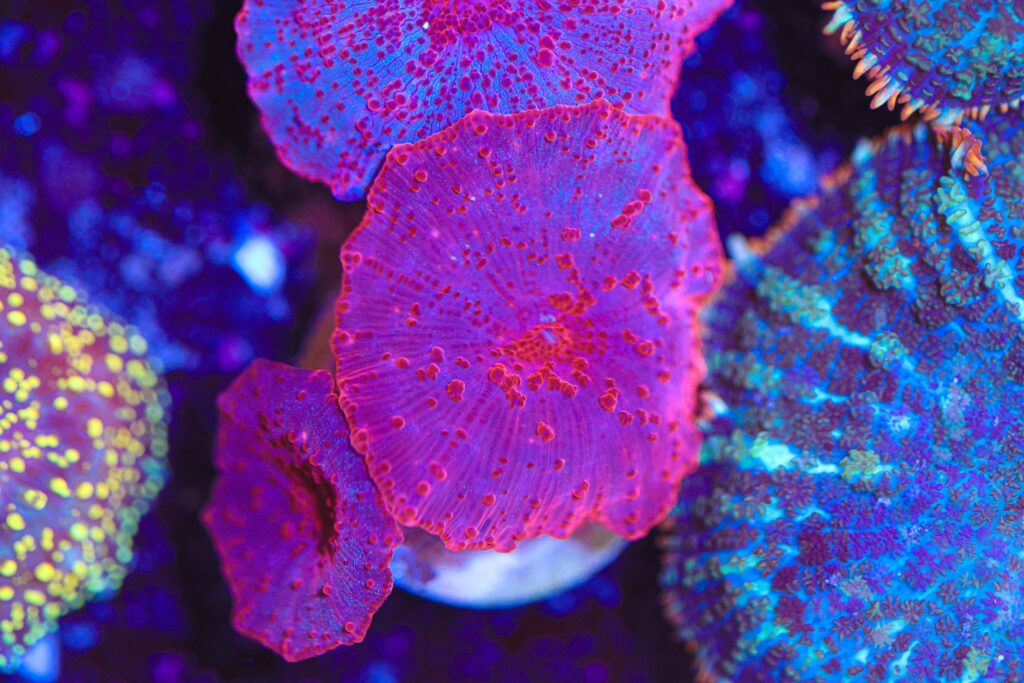
Proper Discosoma Flow
Low flow is essential for Discosoma Mushroom Corals. This is the one care requirement that most frequently causes problems for new reefers. If the flow in your tank is too strong the polyps will lift off the rock and start flowing around the tank on their own, and if they end up somewhere dark or get sucked against a powerhead intake the result is usually death. The flow should be gentle enough that the disc is lying flat against the rock with its foot firmly attached. If you can see the edge of a polyp lifting up it is receiving too much flow. In our farm we run our Discosoma beds in the most sheltered, lowest flow areas of our system and they grow prolifically. A gentle indirect wavemaker is all they need.
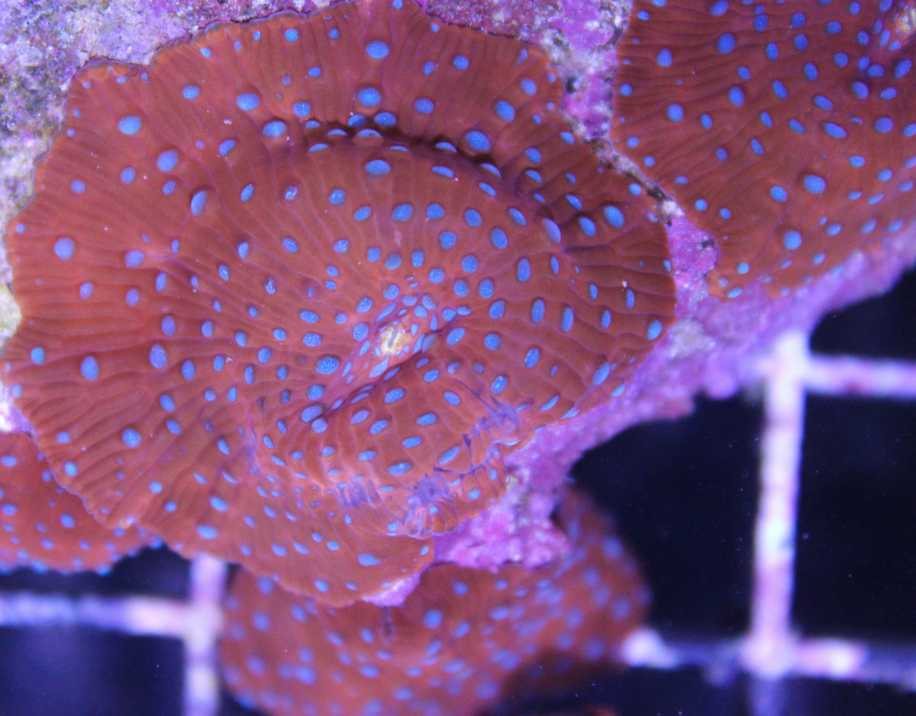
Superman Discosoma — one of the most popular colour morphs in the hobby
Discosoma Growth
Discosoma Mushroom Corals are one of the fastest growing corals available and they reproduce in two ways. The first is pedal laceration — as a mushroom moves slowly across the rock it leaves behind small pieces of its foot, and each piece grows into a new complete polyp over the course of several weeks. This happens constantly and without any intervention, meaning a single mushroom placed on a rock will eventually populate the entire rock on its own given enough time. The second method is by the polyp developing a second mouth and splitting into two separate individuals. Both methods mean that a small mushroom frag or rock can become a densely packed mushroom garden within a year in good conditions.
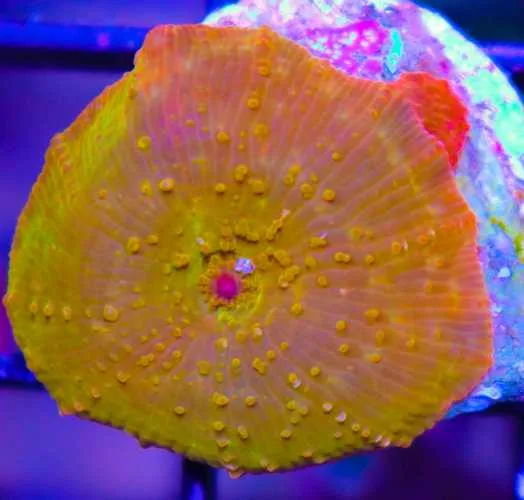
Compatibility
Discosoma Mushroom Corals are generally peaceful and non-aggressive. They do not have sweeper tentacles and will not attack neighbouring corals. However they are not completely harmless — Discosoma can release a mild chemical irritant when stressed and some varieties can sting soft corals or slower-moving LPS they come into contact with through direct physical contact as they spread. The main compatibility concern is their growth habit — they will spread and can grow over slower-growing corals if not managed. Keep them separated from delicate LPS and SPS by a reasonable buffer and trim or frag back any colonies that start encroaching on other corals.
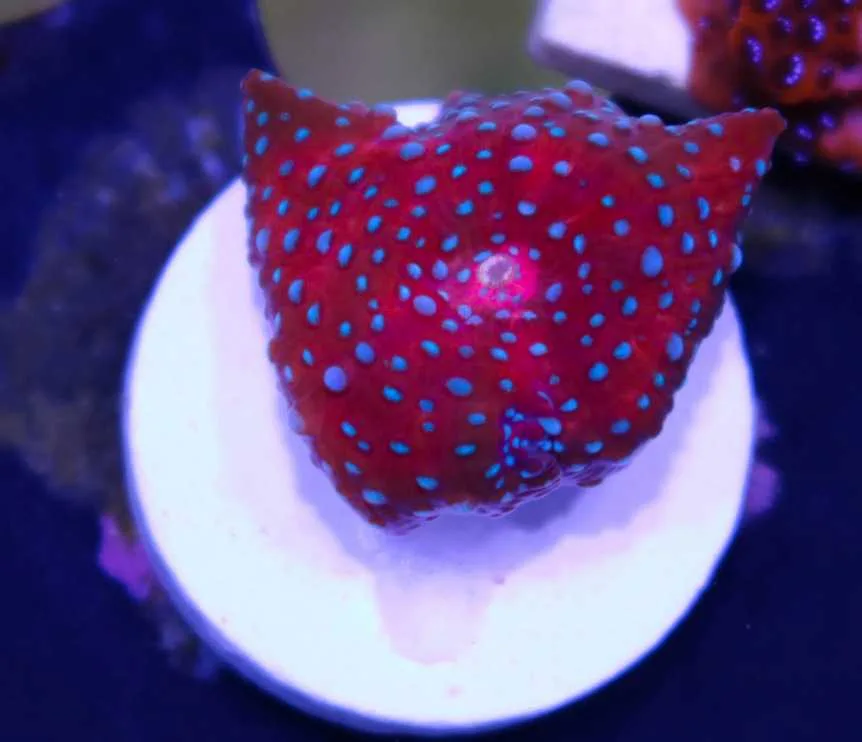
Feeding Discosoma Mushroom Corals
Discosoma are fully photosynthetic and do not need to be fed to thrive. In our farm we grow thousands of Discosoma mushrooms without any supplemental feeding at all — light and stable water quality is all they need. That said they will benefit from one specific supplement more than any other — amino acids. Dosing amino acids into your aquarium benefits corals at a cellular level and Discosoma respond particularly well with improved colour saturation and growth. Direct target feeding of prepared foods is difficult because fish and inverts typically steal any food before the mushroom can consume it. If you want to boost your Discosoma, amino acid dosing is far more effective than trying to target feed them.
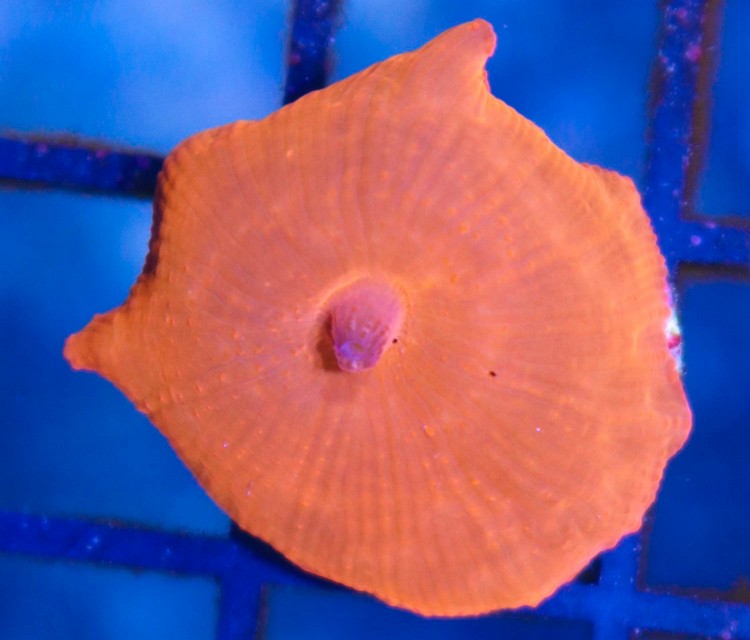
Afterburner Discosoma
Water Chemistry
We always recommend keeping your aquarium within natural sea water parameters — salinity of about 1.026, calcium 450ppm, alkalinity of about 8, and magnesium 1400. Discosoma Mushroom Corals are soft corals and build no hard skeleton, so they are highly tolerant of parameter swings and elevated nutrients. They actually prefer slightly elevated nitrate and phosphate levels compared to pristine SPS tanks — this is one of the reasons they thrive in newer or higher nutrient aquariums that might not be suitable for more demanding corals. Stable parameters always produce better results but Discosoma will tolerate imperfection better than almost any other coral.
Propagation
Discosoma Mushroom Corals are one of the best corals to learn fragging on and we recommend them to anyone who wants to try their first propagation. Using a clean razor blade, take a single polyp and slice it through the mouth. You can make multiple cuts through one polyp as long as each piece retains a small portion of the mouth. Do not worry if you miss the mouth entirely — even a piece without a mouth can regenerate into a full polyp, though it takes longer. Place the frag pieces in a very low flow area on top of some rubble rock — a small container works well for this. They will attach and heal within a few weeks. The tolerance of Discosoma for fragging is remarkable and it is the ideal coral to practice on before moving on to more demanding species.
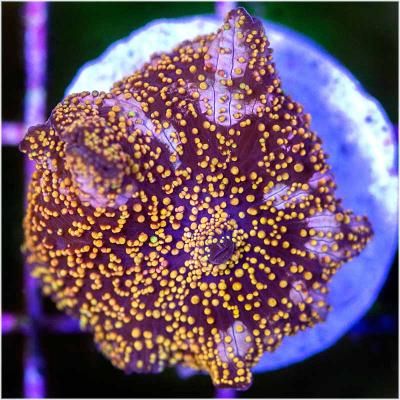
Interstellar Discosoma
Dipping Discosoma Mushroom Corals
It is always good practice to dip any coral before adding it to your tank. Discosoma mushrooms have very few known pests but a quick dip in coral rx or two little fishies revive is still recommended as standard practice for any new addition.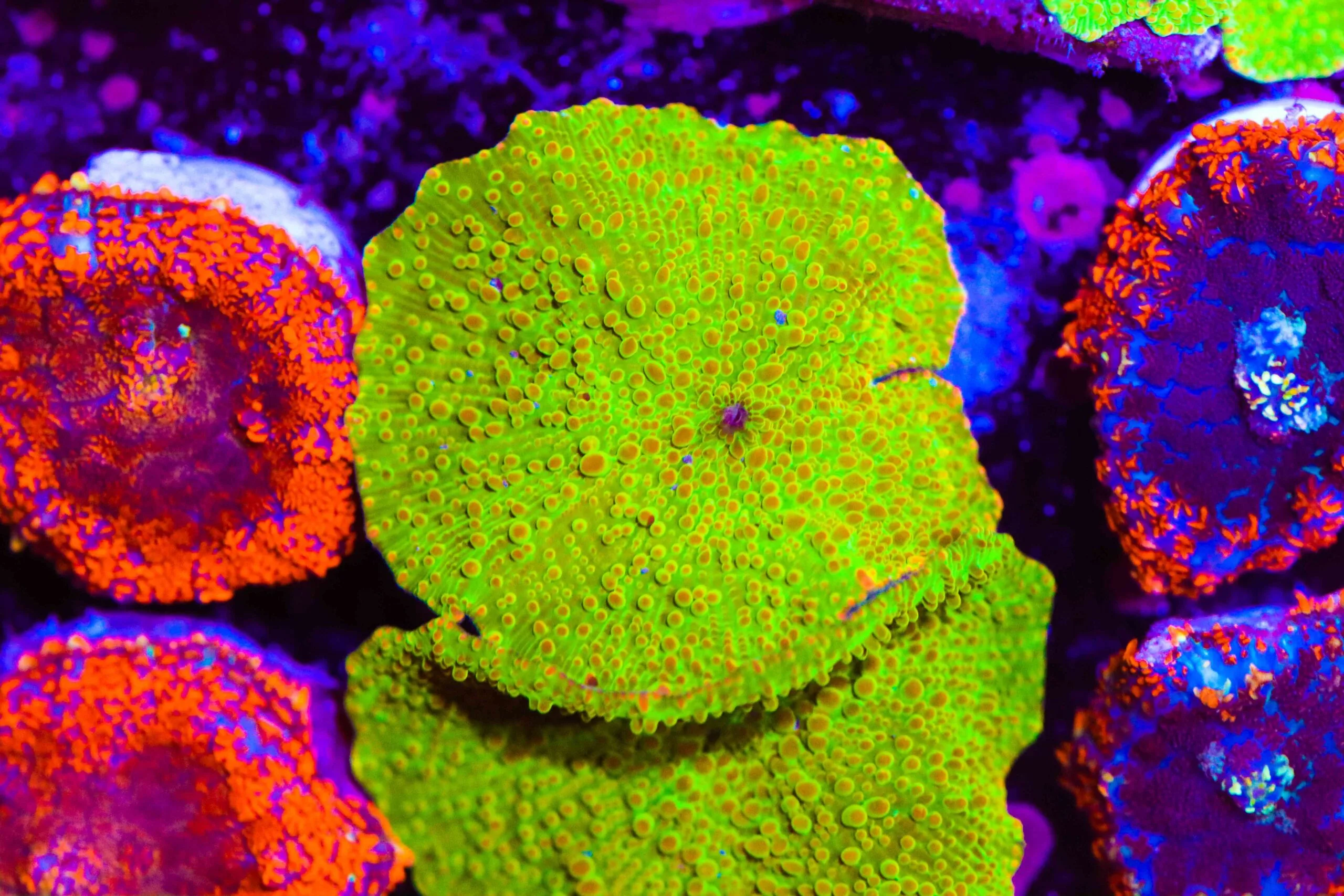
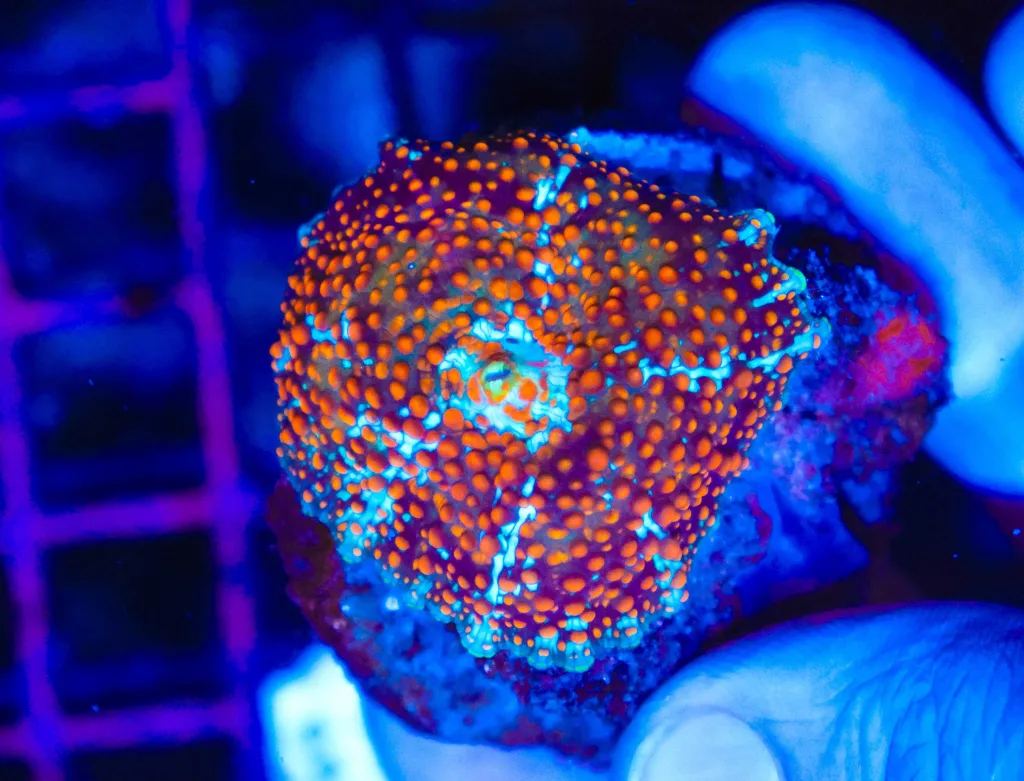
![Wysiwyg Rhodactis Mushroom [F35]](https://fragbox.ca/wp-content/uploads/2026/10/F35-247x296.webp)
![Wysiwyg Ricordea Mushroom [F22]](https://fragbox.ca/wp-content/uploads/2026/09/F22-1-247x296.webp)
![Wysiwyg Mistys Acan [F6]](https://fragbox.ca/wp-content/uploads/2026/09/F6-247x296.webp)
![Wysiwyg Blastomussa Merletti Frag [F15]](https://fragbox.ca/wp-content/uploads/2026/10/F15-247x296.webp)
![Wysiwyg Cherry Acan Frag [F9]](https://fragbox.ca/wp-content/uploads/2026/09/F9-247x296.webp)
![Wysiwyg Blastomussa Frag [F12]](https://fragbox.ca/wp-content/uploads/2026/09/F12-247x296.webp)
![Wysiwyg Epic Blastomussa [F2]](https://fragbox.ca/wp-content/uploads/2026/09/F2-247x296.webp)